
An Implantable Cardioverter Defibrillator (AICD) is a device that is implanted in the chest to monitor and if necessary, correct episodes of rapid heartbeat namely ventricular tachycardia. The AICD sends small electrical charges to the heart to “reset” it when it goes too fast. The AICD stimulates the heart to restore to a normal rhythm. In situations where the heart goes into a ventricular fibrillation, the AICD will give an electric shock (defibrillation) to “reset” the heart to a normal rhythm.
A pacemaker corrects an abnormal heart rhythm that is too slow ie: Bradycardia, whereas AICDs are used to correct a heart rhythm that is too fast ie: tachycardia. An AICD will be used to pace the heart in patients who need both Bradycardia and anti-tachycardia pacing.
Although the main functions of the AICD are Cardioversion and defibrillation, it can also be AICD Implantationprogrammed to do the following:
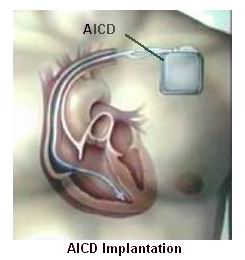
This insertion site will be cleaned, shaved and numbed with the injection of a local anesthetic. A small cut (incision) is made in the chest wall just below the collarbone. Another incision is made in the vein just under the collarbone. The wires of the AICD are passed through the vein and attached to the inner surface of the heart. The other ends of the wires are connected to the main box of the AICD, which is inserted into the tissue under the collarbone and above the breast. Once the AICD is implanted, the physician will test it several times by causing the heart to fibrillate, making sure the AICD responds properly. Because the patient is anesthetized, the patient will not feel this test. The incision is then closed by sutures (stitches), staples or surgical glue. The entire procedure takes about an hour.
Surgery
Immediately following the procedure, a chest x-ray will be taken to confirm the proper placement of the wires in the heart. Patients will rest for several hours and their vital signs will be closely monitored. The AICD’s programming may be adjusted using a magnetic wand that is passed over the chest, during which the patient will not feel anything different.
After the initial operation, the physician may induce ventricular fibrillation or ventricular tachycardia prior to the patient’s discharge. This allows the physician to program the AICD for maximum efficiency.
Depending on the patient’s age and overall health, a short stay in the hospital is usually required following AICD insertion. The physician will provide specific instructions regarding the patient’s appropriate activity level immediately following the procedure. In general, patients may be instructed not to bathe or shower for at least five days after the procedure. They should also avoid contact sports, heavy lifting or vigorous exercise for several weeks, in order to avoid dislodging the wires.
The AICD is implanted into the chest of the patient during a minor surgical procedure (not open-heart surgery). A short stay in the hospital is usually required and some patients may need to take medications that help the heart maintain a normal rhythm (antiarrhythmics). Once the AICD is in place, it runs on batteries for about four to seven years, depending on how often an electric shock is discharged. AICD batteries will not run out unexpectedly. Physicians can detect when the battery is running low during a routine office visit.
People with AICDs need to be careful in certain situations.
Serious complications from the surgery occur in less than 1 percent of cases. These include:
The risk of having one of these complications is increased if people have certain characteristics, such as the following:

Life of AICD
The battery of the AICD is sealed within the main box of the AICD. The whole unit must be replaced when the battery is low. Modern AICDs use lithium batteries that need to be replaced every four to seven years, depending on how often an electric shock is discharged.
When a battery is running low, the elective replacement indicator (ERI) is activated. Physicians can detect this activation during a routine office visit. AICDs will continue to function for approximately six months after the ERI is activated, allowing plenty of time to schedule an elective replacement procedure.
Aside from the ERI, changes may occur in the way the AICD operates that will indicate to a physician that the battery is beginning to run low. Patients may or may not be able to feel these changes in function. Regular communication with one’s physician is an important part of a successful experience with an AICD.
The other cardiac procedures are:
Few Major Hospitals for AICD Implantation are:
Thailand, Malaysia, Singapore, Turkey and India are the most cost effective locations that offer up to almost 80% savings in comparison to the US.
SurgeryPlanet facilitates a plethora of services to the medical treatment traveler also which includes, a hassle free and discounted travel option, a welcome hand at the airport on arrival, travel in an air-conditioned car, round the clock service & support. Your medical evaluation is pre arranged with the least of waiting time. Once your assessment is complete and found medically fit, the procedure is immediately scheduled without a waiting period. Please read through our Services and Testimonials to understand and select your best options.
Hospitals For AICD | Doctors For AICD | Cost For AICD | Treatment AICD | Destinations For AICD | Combo Device Implantation | Implantable Cardioverter Defribillator | Anti Tachycardia Pacing | Bradycardia Pacing | Ventricular Tachycardia | Ventricular Fibrillation | Coronary Heart Disease | Lung Disease | App | App Intracellular Domain | AICD Pacemaker | AICD Defribillator | Cardiac Rhythm | Fibrillate | AICD In India | AICD Information | AICD Malaysia | AICD Thailand | AICD Recovery | AICD Cost Thailand | AICD Duration | AICD Recovery | AICD Risks | AICD Implantation | Life Of AICD | Doctors For AICD | Cost For AICD | Treatment AICD | AICD Overseas | AICD Abroad | AICD Low Cost
SurgeryPlanet is an Healthcare Facilitator and not a Medical service provider. The information provided in this website is not to be used for diagnosis or treatment of any medical condition or use for any medical purposes. We provide information solely for medical travel facilitation and do not endorse any particular health care provider, hospital, facility, destination or any healthcare service or treatment listed. We are not an agent for, or affiliated to any health care provider, or service listed in our website and is not responsible for health care services provided by them. Choice of hospital or doctor for your healthcare services is your independent decision. Consult your domestic licensed health care provider before seeking the services of any health care provider you learn about from our website.