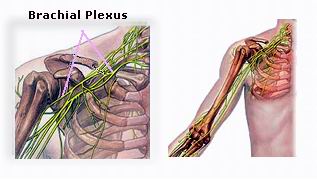
The Brachial Plexus is a nerve network derived from the spinal cord that conduct signals to the shoulder, arm, and hand and controls their movement and sensation. Brachial plexus injuries are nerve injuries in which the nerves and/or the nerve roots of the brachial plexus are damaged. This injury affects the motor and sometimes also sensory functions in the patient’s arm and/or hand. Depending on the severity and extent of the injury the first symptoms may vary individually.
The nerves that make up the brachial plexus originate from the spinal cord and correspond to four cervical vertebrae and one thoracic vertebra.
Some patients have good or moderate use of their fingers, but little or no control over the muscles of shoulder and elbow. Certain others can use their arm, but althave little or no control of the fingers. Some patients have a completely flaccid limb with no sensory or motor functions.
The injury can also be bilateral in which case both arms are affected. The purpose of nerve surgery is to improve the functions of the arm. Nerve surgery is most effective when it is done between the ages of 5 and 12 months. After children turn 1 years old, the surgery may not be as successful, but surgery can still help children over 5 years of age that have still not recovered from this injury.
For some children, neurosurgery is not recommended or is not successful. In these instances, other procedures can be done to transfer muscles and tendons. This surgery is done by a plastic surgeon when the child is older and gives better use of the arm. After the surgery, children are usually in the hospital for two days. Four weeks after surgery you can begin doing the exercises again at home.
Diagnosis
The injury is diagnosed using MRIs, CT scans and an electro-diagnostic test known as EMG to assess nerve function and is commonly used in the evaluation of brachial plexus injuries. This helps in determining the extent and the location of the injury.
Symptoms
Symptoms include numbness, weakness in the muscles in the shoulder, arm, and hand, along with a burning sensation. Patients with a severe avulsion injury may also have a drooping eyelid, a phenomenon known as Horner’s Syndrome.
The common injuries are:
The nerves are carefully examined and their functions are checked. Any scar tissue (neuroma) around the injury is removed. The nerve conduction and functions are checked again. In certain cases nerve grafts have to be used and these are harvested and transplanted from the back of the leg called the sural nerve. The removal of the Sural nerve will not impair coordination or strength in that leg. After the surgery an immobilizer is put on the arm. It cannot move out more than 45 degrees because the injury needs time to heal. The wrap must be worn for four weeks for progress to occur.
Tests
The patient may have a nerve conduction study (EMG or electromyography test) prior to surgery.
The surgery will take anywhere from 4 to 12 hours. Hospital stay would be for a couple of days. The arm will be in a sling and wrapped in an Ace bandage to restrict movement. This helps manage the pain as well. Hospital stay will be for a couple of days. One may notice some improvement within 4 weeks. A nerve graft will usually show results within 6 months. Some progress and improvement may continue for almost two years.
For some, Brachial Plexus Surgery is the best way to regain nerve control.
The other Neurology Procedures are:
Few Major Hospitals for Brachial Plexus Surgery are:
Thailand, Malaysia, Singapore, Turkey and India are the most cost effective locations that offer up to almost 80% savings in comparison to the US.
SurgeryPlanet facilitates a plethora of services to the medical treatment traveler also which includes, a hassle free and discounted travel option, a welcome hand at the airport on arrival, travel in an air-conditioned car, round the clock service & support. Your medical evaluation is pre arranged with the least of waiting time. Once your assessment is complete and found medically fit, the procedure is immediately scheduled without a waiting period. Please read through our Services and Testimonials to understand and select your best options.
Major Treatments Abroad: Obesity / Bariatric Surgery | Spine Surgery | Stem Cell therapy | Fertility treatment | Knee replacement in India and Thailand | Heart Surgery | Organ transplant | Ayurveda Treatment | Heart valve replacement | Hip resurfacing | Hospitals in India and Thailand for Laparoscopic Sterilization| Best hospitals in Asia | JCI & ISO certified Hospitals | Cost effective medical procedures | Healthcare tourism | Complete privacy for affordable cost | Weight loss procedures | Infertility treatment | Board certified physicians | Low cost surgeries
SurgeryPlanet is an Healthcare Facilitator and not a Medical service provider. The information provided in this website is not to be used for diagnosis or treatment of any medical condition or use for any medical purposes. We provide information solely for medical travel facilitation and do not endorse any particular health care provider, hospital, facility, destination or any healthcare service or treatment listed. We are not an agent for, or affiliated to any health care provider, or service listed in our website and is not responsible for health care services provided by them. Choice of hospital or doctor for your healthcare services is your independent decision. Consult your domestic licensed health care provider before seeking the services of any health care provider you learn about from our website.