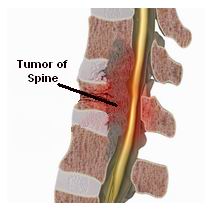
Spinal Cord Tumors
A spinal cord tumor is a non-cancerous (benign) or cancerous (malignant) growth in or around the spinal cord. They may originate in the cells within or next to the spinal cord. Only about 10% of primary spinal cord tumors originate in the cells within the spinal cord. These tumors can extend within the cord and cause a fluid-filled cavity (syrinx) to form.
Causes
Exact cause of this is not known.
Symptoms
Symptoms are caused by pressure on the spinal cord and nerve roots. Pressure on the spinal cord may cause the following:
Pressure on the spinal cord may also block the blood supply to the cord, resulting in death of tissue, fluid accumulation, and swelling. Fluid accumulation may block more of the blood supply, leading to a vicious circle of damage. Symptoms due to pressure on the spinal cord can worsen quickly.
Pressure on spinal nerve roots can cause pain, numbness, tingling, weakness in areas supplied by the compressed nerve root. Pain may radiate along the nerve whose root is compressed. If compression continues, the affected muscles may waste away. Walking may become difficult.
Diagnosis
Several procedures can help doctors diagnose a spinal cord tumor. Magnetic resonance imaging (MRI) is considered the best procedure for examining all the structures of the spinal cord and spine. When MRI is unavailable, myelography with computed tomography (CT) may be done instead. X-rays of the spine can show only changes in the bones, and many tumors do not affect the bone when they are in an early stage.
A biopsy is usually needed to diagnose the precise type of tumor, especially primary spinal cord tumors. However, a biopsy is not needed for spinal cord tumors that result from metastases if cancer has been diagnosed elsewhere in the body. Often, a biopsy requires surgery, but sometimes it can be done using a needle with computed tomography (CT) or MRI to guide doctors as they place the needle in the tumor.
Treatment
If symptoms suggest that the tumor is compressing the spinal cord, corticosteroids are immediately given in high doses to reduce the swelling. Such tumors are treated as soon as possible, often surgically.
Many tumors of the spinal cord and spine can be removed surgically. If tumors cannot be removed, radiation therapy is used, sometimes after surgery to relieve the pressure on the spinal cord is done.
Recovery generally depends on how quickly treatment begins and how much damage was done. Removal of meningiomas, neurofibromas, and some other primary spinal cord tumors may be curative.
The other Oncology Procedures are
Few Major Hospitals for treatment of Spinal Cord Tumor are
Thailand, Malaysia, Singapore, Turkey and India are the most cost effective locations that offer up to almost 80% savings in comparison to the US.
SurgeryPlanet facilitates a plethora of services to the medical treatment traveler also which includes, a hassle free and discounted travel option, a welcome hand at the airport on arrival, travel in an air-conditioned car, round the clock service & support. Your medical evaluation is pre arranged with the least of waiting time. Once your assessment is complete and found medically fit, the procedure is immediately scheduled without a waiting period. Please read through our Services and Testimonials to understand and select your best options.
Major Treatments Abroad: Obesity / Bariatric Surgery | Spine Surgery | Stem Cell therapy | Fertility treatment | Knee replacement in India and Thailand | Heart Surgery | Organ transplant | ../ayurveda Treatment | Heart valve replacement | Hip resurfacing | Hospitals in India and Thailand for Laparoscopic Sterilization| Best hospitals in Asia | JCI & ISO certified Hospitals | Cost effective medical procedures | Healthcare tourism | Complete privacy for affordable cost | Weight loss procedures | Infertility treatment | Board certified physicians | Low cost surgeries
SurgeryPlanet is an Healthcare Facilitator and not a Medical service provider. The information provided in this website is not to be used for diagnosis or treatment of any medical condition or use for any medical purposes. We provide information solely for medical travel facilitation and do not endorse any particular health care provider, hospital, facility, destination or any healthcare service or treatment listed. We are not an agent for, or affiliated to any health care provider, or service listed in our website and is not responsible for health care services provided by them. Choice of hospital or doctor for your healthcare services is your independent decision. Consult your domestic licensed health care provider before seeking the services of any health care provider you learn about from our website.