Individuals with degenerated discs in the lower (lumbar) spine may suffer from chronic low back pain. Most patients with symptomatic degenerative conditions in the spine are treated non-surgically with anti-inflammatory medications, physio therapy and corticosteroid injections. Many of these patients Artificial Dischave a positive response to non-surgical methods of treatment, but there are a number of patients who continue to experience “chonic” and disabling pain that may interfere with the patient’s ability to work.
Artificial Disc Replacement Surgery
The spine is a column that is made of up bones and discs. The blocks of bone (or vertebrae) provide the anterior support and structure of the spine. Posteriorly, the two facet joints at each level provide stability and movement of the motion segment. The spinal discs are in between the bones and act like a cushion or “shock absorber” between the vertebrae and also contribute to the flexibility and motion of the spinal column.
Disc material is primarily composed of water and other proteins. As a normal part of aging, the water content gradually diminishes which can cause the disc to flatten out and even develop tears or cracks throughout the annulus fibrosus. These discs are often referred to as “degenerative” discs and may or may not cause pain.
In the case of a degenerative disc, the inner jelly material can bulge out and press up against the annulus fibrosus. This can stimulate the pain receptors causing back pain to occur. The cracks or tears that develop within the annulus fibrosus can also become a source of pain. Back pain that is caused by the spinal disc is often referred to as discogenic low back pain.
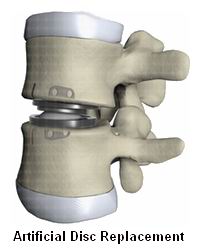
The purpose and advantage of artificial disc replacement is to replace the worn out disc, while preserving the motion at the operated spinal level. This could potentially not only treat the underlying back pain, but also protect patients from developing problems at an adjacent level of the spine.
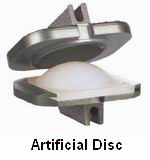
An artificial disc is a three-piece device consisting of a sliding core sandwiched between two metal endplates. The sliding core is made from a medical grade plastic and the end plates are made from medical grade cobalt chromium alloy. These materials usually do not harm the human body and are used in other medical implants. The implant is designed to move like a normal disc, thereby maintaining the desired flexibility of the spine.
As with any surgery, there are some possible complications that can occur when you have disc replacement surgery with the Artificial Disc. Complications can occur singly or in combination and may include:
The other Spine Surgery Procedures are:
Few Major Hospitals for Artificial Disc Replacement Surgery are:
Thailand, Malaysia, Singapore, Turkey and India are the most cost effective locations that offer up to almost 80% savings in comparison to the US.
SurgeryPlanet facilitates a plethora of services to the medical treatment traveler also which includes, a hassle free and discounted travel option, a welcome hand at the airport on arrival, travel in an air-conditioned car, round the clock service & support. Your medical evaluation is pre arranged with the least of waiting time. Once your assessment is complete and found medically fit, the procedure is immediately scheduled without a waiting period. Please read through our Services and Testimonials to understand and select your best options.
Major Treatments Abroad: Obesity / Bariatric Surgery | Spine Surgery | Stem Cell therapy | Fertility treatment | Knee replacement in India and Thailand | Heart Surgery | Organ transplant | Ayurveda Treatment | Heart valve replacement | Hip resurfacing | Hospitals in India and Thailand for Laparoscopic Sterilization| Best hospitals in Asia | JCI & ISO certified Hospitals | Cost effective medical procedures | Healthcare tourism | Complete privacy for affordable cost | Weight loss procedures | Infertility treatment | Board certified physicians | Low cost surgeries
SurgeryPlanet is an Healthcare Facilitator and not a Medical service provider. The information provided in this website is not to be used for diagnosis or treatment of any medical condition or use for any medical purposes. We provide information solely for medical travel facilitation and do not endorse any particular health care provider, hospital, facility, destination or any healthcare service or treatment listed. We are not an agent for, or affiliated to any health care provider, or service listed in our website and is not responsible for health care services provided by them. Choice of hospital or doctor for your healthcare services is your independent decision. Consult your domestic licensed health care provider before seeking the services of any health care provider you learn about from our website.