A partial denture can be used for people who have lost several teeth. A complete denture is used to replace missing teeth for people with no remaining teeth. Loss of tooth can occur from injury, decay of tooth or periodontal disease. If the gaps of missing teeth are not closed, there can be a shift in remaining teeth which can lead to an inability to proper biting and chewing. It also tends to change the facial appearance making one appear older than they are.
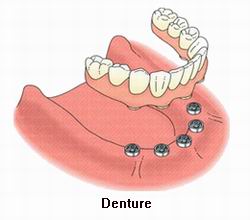
Dentures are very comfortable and functional and similar in appearance to natural teeth. They can improve a smile or facial appearance.When not in use dentures are stored in cold water. This also helps in cleaning them off food particles.
Adapting to Dentures
You should see your dentist a day after the delivery of your new dentures. Initially it is common to undergo some discomfort. Small adjustments to the denture can increase your comfort level and eliminate problems before they become more serious. At first, a new denture may feel strange in the mouth. The cheeks, lips and tongue are very sensitive areas that require time to adapt to the new dentures. You might bite your cheek or tongue while getting used to your new dentures. However, if the soreness or irritation persists, report it to your dentist immediately.
In addition to adjusting to the feel of new dentures, it will also take some practice learning to chew with them. Begin by slowly chewing on very small pieces of soft food, using both sides of the mouth simultaneously. As your comfort and confidence increase you can progress to larger pieces of soft food and then proceed to harder foods.
Speaking may also require practice. Pronunciation of certain words can be difficult. Usually, this problem is overcome within two weeks. Practicing to read aloud helps new denture wearers to adjust more quickly to their new prosthesis.
With a well fitting denture and practice, denture adhesives may not be necessary. Denture wearers should expect the lower denture to fit somewhat loosely. They may need to learn how to use the muscles of the cheeks and tongue to keep the denture in place. Although this might sound bothersome, with practice, it becomes second nature.
Denture Readjustment or Replacement
If your dentures fit poorly, cause persistent mouth irritation, chip, crack or break, it is important to see your dentist. Although most gum remodeling occurs within the first year, changes in gums and bone continue throughout one's lifetime. Over time this may result in ill fitting or loose dentures and may compromise facial appearance.
In addition, movement of the dentures on the gums may cause significant irritation. For this reason, it is recommended that complete dentures be remade or at least relined every five to seven years.
The cost of dentures depends on several factors, including:
Your dentist will first examine your gums and supporting bone structure to identify the appropriate treatment plan. In certain cases corrective oral surgery may be performed. Any remaining teeth may be extracted before the selection and placement of dentures. An impression of the gums is made to identify every ridge and crevice to ensure the best denture fit. An immediate denture enable proper healing of the extraction sites and can be easily modified for changing ridge contours during healing until the final dentures are made. The color of the denture is chosen to closely match with your teeth and gums.
Measurements for complete dentures are made when gums are restored to a healthy condition and sufficient time has passed for healing. The natural shrinking of gums due to tooth loss takes from 6 to 12 months. The temporary dentures can be adjusted to accommodate the changes in the gums and underlying bone structure.
An overdenture is a removable dental prosthesis that covers and rests on one or more remaining tooth roots. A removable partial denture is a dental prosthesis that replaces some teeth and is built around existing natural teeth. Both the overdenture and the removable partial denture may be connected to the remaining tooth roots or remaining natural teeth with anchors made of metal or plastic. These connections improve stability and the retention of both prostheses.
The other Dental Procedures are:
Few Popular Hospitals for Dental Laser Whitening are:
Thailand, Malaysia, Singapore, Turkey and India are the most cost effective locations that offer up to almost 80% savings in comparison to the US.
SurgeryPlanet facilitates a plethora of services to the medical treatment traveler also which includes, a hassle free and discounted travel option, a welcome hand at the airport on arrival, travel in an air-conditioned car, round the clock service & support. Your medical evaluation is pre arranged with the least of waiting time. Once your assessment is complete and found medically fit, the procedure is immediately scheduled without a waiting period. Please read through our Services and Testimonials to understand and select your best options.
Major Treatments Abroad: Obesity / Bariatric Surgery | Spine Surgery | Stem Cell therapy | Fertility treatment | Knee replacement in India and Thailand | Heart Surgery | Organ transplant | Ayurveda Treatment | Heart valve replacement | Hip resurfacing | Hospitals in India and Thailand for Laparoscopic Sterilization| Best hospitals in Asia | JCI & ISO certified Hospitals | Cost effective medical procedures | Healthcare tourism | Complete privacy for affordable cost | Weight loss procedures | Infertility treatment | Board certified physicians | Low cost surgeries
SurgeryPlanet is an Healthcare Facilitator and not a Medical service provider. The information provided in this website is not to be used for diagnosis or treatment of any medical condition or use for any medical purposes. We provide information solely for medical travel facilitation and do not endorse any particular health care provider, hospital, facility, destination or any healthcare service or treatment listed. We are not an agent for, or affiliated to any health care provider, or service listed in our website and is not responsible for health care services provided by them. Choice of hospital or doctor for your healthcare services is your independent decision. Consult your domestic licensed health care provider before seeking the services of any health care provider you learn about from our website.