Shoulder replacement surgery is a highly technical procedure; each step plays a critical role in the outcome.
After administering anesthesia, an incision is made across the front of the shoulder from the middle of the collarbone to the middle of the arm bone. This allows access to the joint without damaging the important deltoid or pectoralis muscles that are responsible for a significant portion of the shoulder's power.
Scar tissue that may be restricting the movement of the muscles and other tissues near the shoulder are removed hence increase mobility. The tendon of the subscapularis muscle is removed to gain access to the joint and released circumferentially to restore its length and mobility. The arthritic humeral head (ball of the joint) is removed and the bone spurs are removed to prepare the bone for the humeral prosthesis.
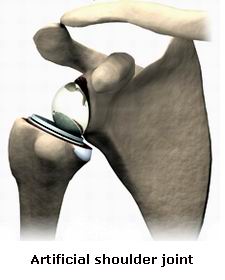
A hemiarthroplasty may be performed, if the glenoid socket is unaffected or is in other selected conditions. In a cuff tear arthropathy, a hemiarthroplasty (replacing the humeral joint surface only) is usually selected because the anatomy does not favor the use of a glenoid prosthesis. The humeral component is made of metal and is usually press fit, but sometimes cemented, into the shaft of the bone of the humerus.
If the glenoid is affected and conditions do not favor the insertion of a glenoid component, a non-prosthetic glenoid arthroplasty may be performed along with a humeral hemiarthroplasty. In this procedure, the glenoid shape and orientation are corrected without inserting a glenoid prosthesis. The prosthetic ball of the humeral component articulates with the reshaped bony socket of the glenoid. This procedure may be selected when the patient is interested in performing heavy activities that might jeopardize the fixation of a polyethylene glenoid component.
In a total shoulder joint replacement, the glenoid bone is shaped and oriented as in the non-prosthetic glenoid arthroplasty and then covered with a polyethylene glenoid component, as seen in the figure. A small amount of bone cement is used to hold the artificial glenoid socket in place.
At the conclusion of any of these procedures, the subscapularis tendon is securely repaired to the bone. This repair requires protection from active use for at least 6 weeks while it is healing.
Anesthetic
A general anesthetic or a brachial plexus nerve block can be used for a shoulder joint replacement surgery. A brachial plexus block can provide anesthesia for several hours after the surgery. Preferences are discussed with the anesthesiologist before surgery.
Length of shoulder replacement surgery
The procedure usually takes approximately two hours, however the preoperative preparation and the postoperative recovery may add several hours to this time. Patients often spend two hours in the recovery room and two to four days in the hospital after surgery.
Recovery of comfort and function after shoulder arthroplasty continues for the first year after surgery. The rehabilitation is carried out largely by the patient under the supervision of the surgeon. Shoulder replacement arthroplasty is a major surgical procedure that involves cutting of skin, tendons and bone. Anesthesia and pain medications can help manage the pain from this surgery.
After surgery the patient is shifted to the recovery room and stays there for about an hour. A drainage tube is usually used to remove excess fluid from the surgical area. The tube is usually removed after a couple of days of doing the surgery. Bandages that cover the incision area are usually changed the second day after surgery.
As soon as the incision area is dry and shoulder is comfortable with the oral pain medications, the patient can be discharged. It is also made sure that the patient can perform the range of motion exercises and home support systems for the patient are in place. Typically, discharge happens on the third or fourth day after the surgery.
Early motion after total shoulder replacement helps achieve the best possible shoulder function. However, after surgery scar tissue will tend to recur and limit movement unless motion is started immediately.
The other Orthopedic Procedures are:
Few Major Hospitals for Total Shoulder Endoprosthesis are:
Thailand, Malaysia, Singapore, Turkey and India are the most cost effective locations that offer up to almost 80% savings in comparison to the US.
SurgeryPlanet facilitates a plethora of services to the medical treatment traveler also which includes, a hassle free and discounted travel option, a welcome hand at the airport on arrival, travel in an air-conditioned car, round the clock service & support. Your medical evaluation is pre arranged with the least of waiting time. Once your assessment is complete and found medically fit, the procedure is immediately scheduled without a waiting period. Please read through our Services and Testimonials to understand and select your best options.
Major Treatments Abroad: Obesity / Bariatric Surgery | Spine Surgery | Stem Cell therapy | Fertility treatment | Knee replacement in India and Thailand | Heart Surgery | Organ transplant | Ayurveda Treatment | Heart valve replacement | Hip resurfacing | Hospitals in India and Thailand for Laparoscopic Sterilization| Best hospitals in Asia | JCI & ISO certified Hospitals | Cost effective medical procedures | Healthcare tourism | Complete privacy for affordable cost | Weight loss procedures | Infertility treatment | Board certified physicians | Low cost surgeries
SurgeryPlanet is an Healthcare Facilitator and not a Medical service provider. The information provided in this website is not to be used for diagnosis or treatment of any medical condition or use for any medical purposes. We provide information solely for medical travel facilitation and do not endorse any particular health care provider, hospital, facility, destination or any healthcare service or treatment listed. We are not an agent for, or affiliated to any health care provider, or service listed in our website and is not responsible for health care services provided by them. Choice of hospital or doctor for your healthcare services is your independent decision. Consult your domestic licensed health care provider before seeking the services of any health care provider you learn about from our website.