Introduction
Many people travel to other countries for surgery each year. When you plan medical travel, you must compare hospitals very carefully. Hospital accreditation can be one useful factor when you review hospital quality and safety systems.
You should also review surgeon information, surgical services, hospital facilities, safety practices, costs, communication, and recovery care. Keep in mind that accreditation does not guarantee a successful surgery. It only gives you information about how a hospital runs its safety systems.
What Is Hospital Accreditation?
Hospital accreditation is a formal review process. Independent groups check if a hospital meets high standards for patient care and safety.
- What it means: An accredited hospital has passed outside tests.
- Why hospitals apply: Hospitals seek this status to show they care about quality.
- How reviews work: Experts look at hospital rules, staff training, and clean spaces.
Accreditation programs look closely at safety and care processes. Different groups have different rules, so the type of review may vary by hospital.
Why Accreditation May Matter for Surgery Abroad
When you choose a surgical hospital in another country, accreditation can help you compare your options. It gives you a way to look at hospital quality systems before you travel.
- Patient safety: Accredited sites often follow strict safety rules.
- Infection control: Clean rooms help lower the risk of post-surgery illness.
- Staff training: Hospitals must prove their medical teams are properly trained.
- Medicine safety: Clear rules help nurses give the right drugs safely.
- Clear records: Good charts help doctors track your care step by step.
Accreditation gives you insight into hospital systems. However, it does not remove all risks linked to surgery.
How Accreditation May Support Surgical Safety
Hospital standards cover many parts of your hospital stay. They help hospitals build systems to protect patients from simple mistakes.
- Safe checks: Staff use ID bands to make sure they treat the right person.
- Surgery steps: Teams check the correct body part before the operation starts.
- Anesthesia care: Trained experts monitor your breathing and sleep during surgery.
- Emergency readiness: Hospitals must have tools and plans ready if problems occur.
Accreditation does not prevent every complication or surgical error. It just shows that the hospital has systems in order to reduce risks.
Why This Matters More When Having Surgery Abroad
Traveling for medical care brings unique challenges. You are far from home, and things may work differently than they do in your local clinic.
- Different rules: Foreign countries may have different laws for medical care.
- Language barriers: It can be hard to talk with staff if you speak different languages.
- Record transfers: Moving your medical history across borders takes careful planning.
- Follow-up care: You must plan how you will heal once you return home.
Checking hospital quality info helps you compare choices and plan your trip with open eyes.
Accreditation Is Only One Factor
You should never pick a hospital based only on its accreditation status. Many other details matter just as much for a safe trip.
- Surgeon skills: Look at the doctor’s training and past work experience.
- Hospital tools: Check if the clinic has intensive care units if you need them.
- Support services: Good hospitals help international patients with translation and travel.
- Clear costs: Make sure you know all fees before you sign any forms.
Do not rank hospitals or call any single clinic the best. Every patient has unique needs.
Hospital Quality Factors Compared
| Factor | What Patients Can Check | Why It May Matter |
|---|---|---|
| Accreditation | Current status and scope | Shows that certain standards were reviewed |
| Surgical services | Procedures and related care | Helps match the hospital to the planned surgery |
| Surgeon information | Qualifications and relevant experience | Helps patients understand who may provide care |
| Safety systems | Infection and surgical safety processes | Gives insight into hospital safety practices |
| Emergency support | Emergency and critical care services | May matter if complications occur |
| Follow-up care | Recovery and post-surgery support | Helps with care after surgery |
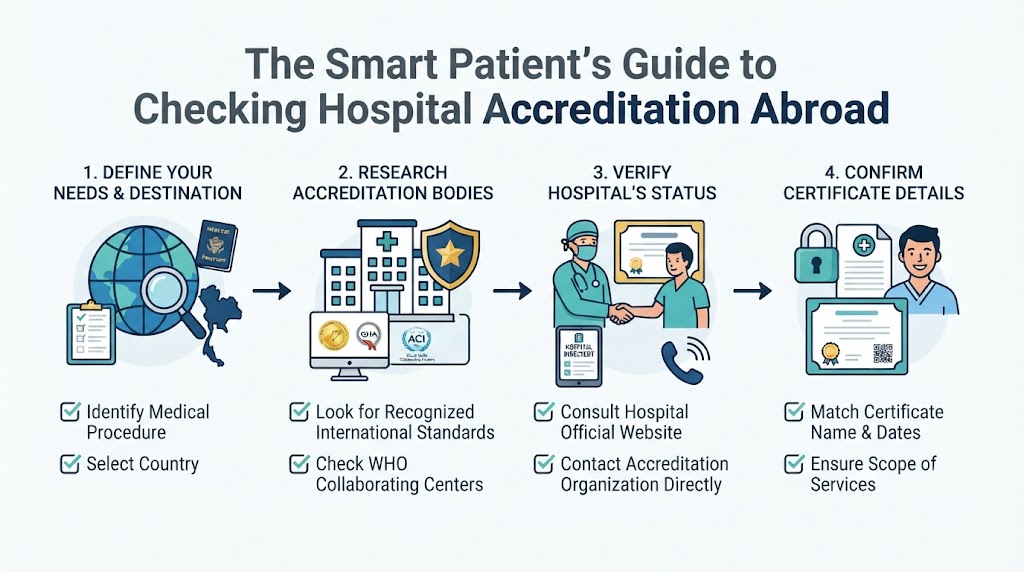
How Patients Can Check Hospital Accreditation
You can take practical steps to look into a hospital’s claims before you book your trip.
- Look at the website: See if the hospital lists its accreditation status clearly.
- Find the group: Check the name of the organization that gave the award.
- Check the dates: Make sure the accreditation is active right now.
- Read the scope: See if the award covers the exact department you need.
- Ask questions: Call the hospital and ask for copies of their certificates if needed.
Always use official info. Never guess or trust old claims without proof.
Questions to Ask Before Surgery Abroad
- Is the hospital currently accredited?
- Which organization provided the accreditation?
- What does the accreditation cover?
- Is the accreditation current?
- What safety processes are used before surgery?
- What infection prevention measures are followed?
- What emergency support is available?
- What anesthesia services are available?
- What follow-up care is provided?
- Who will help international patients with communication and records?
Other Things to Check Before Choosing a Surgical Hospital
Accreditation is a helpful tool, but you must check the full picture before you travel for medical care.
- Look closely at the surgeon’s background and history of work.
- Check if the facility has the right tools for your specific operation.
- Ask about infection rates and room cleaning steps.
- Read up on how the team handles post-surgery recovery.
- Talk to past patients if you can find honest reviews.
Always verify important details directly with the hospital and your local doctor.
Common Mistakes Patients Should Avoid
- Choosing a hospital only because it has an award.
- Assuming accreditation guarantees a perfect surgery.
- Forgetting to check if the certificate is still active today.
- Picking a place only because the price is very low.
- Ignoring the background of the actual surgeon.
- Not planning how to get help once you return home.
Simple Checklist for Surgery Abroad
- Check the hospital’s current accreditation.
- Identify the accreditation organization.
- Check what the accreditation covers.
- Review the surgical services.
- Check surgeon information.
- Ask about infection prevention.
- Ask about anesthesia and emergency support.
- Confirm international patient services.
- Ask about recovery and follow-up care.
- Confirm important cost details.
- Keep copies of medical records.
Frequently Asked Questions
What is hospital accreditation? Hospital accreditation is a review process where an independent group checks if a hospital meets high standards for patient safety and quality care.
Why does accreditation matter for surgery abroad? It helps you compare hospitals in other countries by showing which facilities follow tested quality and safety rules.
Does accreditation guarantee safe surgery? No. Accreditation does not remove all risks or guarantee a successful outcome. It only shows that the hospital follows specific safety standards.
How can I check if a hospital is accredited? You can check the hospital’s official website, look up the accreditation group’s public directory, or ask the hospital team for current details.
What does hospital accreditation cover? It often covers safety systems, cleanliness, patient IDs, staff training, medicine management, and emergency readiness.
What should I check besides accreditation? You should also check the surgeon’s training, hospital facilities, emergency care, costs, and how the team handles follow-up recovery.
Why is follow-up care important after surgery abroad? Good follow-up care helps you heal properly, catches early problems, and ensures your local doctor can manage your long-term health.
What questions should I ask about hospital accreditation? Ask which group gave the award, what exact services it covers, and if the status is active right now.
Conclusion
Hospital accreditation can give surgery-abroad patients useful information about hospital quality and safety systems. It is only one part of your hospital selection process. You should also review surgeon information, surgical services, hospital facilities, safety systems, communication, cost, recovery, and follow-up care. Take your time to verify all important details with the hospital and qualified health professionals before you travel for surgery.