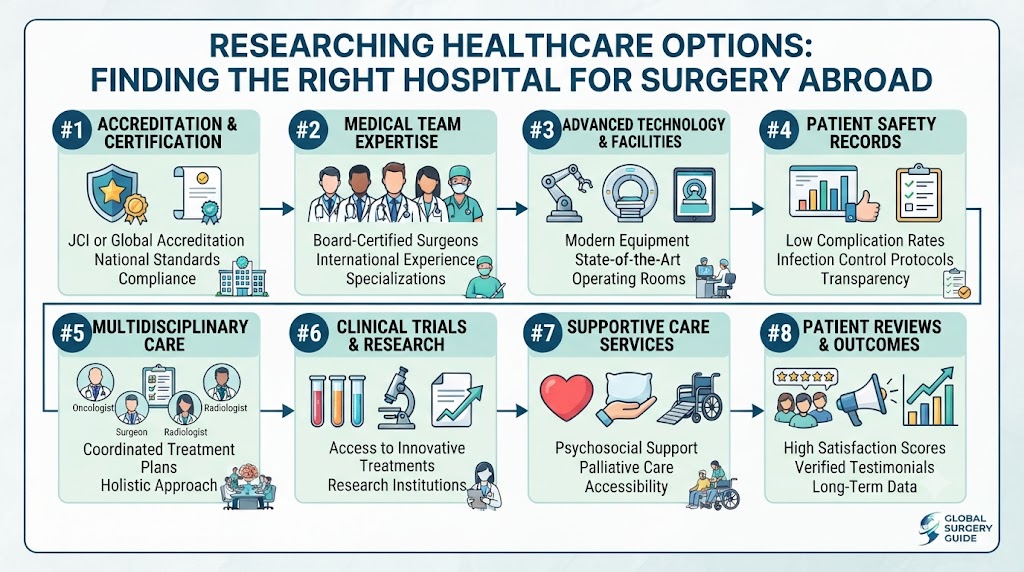
Introduction
Choosing a hospital abroad for international surgery can feel overwhelming. When you or a family member needs a surgical procedure in another country, you might discover that hospitals offer varying levels of experience, facilities, and international patient support. It is easy to focus solely on treatment prices or promotional rankings, but making an informed choice requires looking deeper into what each healthcare facility can provide.
Imagine sitting with your family after a doctor suggests a planned surgical procedure, and you start exploring options overseas. You find three different international surgery hospitals in different countries. One offers an attractive package price, another has a well-known name, and a third is recommended through an online forum. None of them look identical. You start wondering how to look past the marketing descriptions to find out which hospital actually has the right surgical experience for your specific condition.
Different hospitals have different clinical strengths, and understanding surgeon qualifications, hospital facility standards, transparent costs, international support, and follow-up care helps you make a confident decision. Resources like SurgeryPlanet can help patients research international surgery options and explore hospital information before making a choice.
Featured Snippet
How Do You Choose the Right Hospital for International Surgery?
Patients can choose the right hospital by comparing hospital experience, surgeon qualifications, relevant treatment services, facility standards, quality information, international patient support, total treatment costs, and recovery care. The right hospital always depends on the patient’s specific medical needs, individual situation, and professional guidance.
Why Hospital Selection Matters for International Surgery
Surgery Is a Major Healthcare Decision
Undergoing surgery is a significant step that requires careful planning, skilled medical teams, and reliable facility support. When traveling abroad, you are stepping away from your local support network, making hospital selection even more critical to your safety and comfort.
Variations in Experience and Support
Hospitals differ significantly in their surgical volume, specialized equipment, nursing care, and international patient coordination. Reviewing these factors ahead of time helps prevent unexpected challenges during your care journey.
Understand Your Surgery Need First
Before researching hospitals abroad, it is important to have a clear understanding of your medical needs. Discuss your diagnosis with a qualified healthcare professional in your home country. Find out what type of surgery you require, whether a second opinion is recommended, and what alternative treatments might exist. Knowing your clinical requirements helps you ask the right questions when speaking with international medical providers.
Hospital Experience
Check whether the hospital regularly performs the specific type of surgery you are considering. Facilities with higher case volumes for a particular procedure often have experienced surgical teams and structured protocols for managing patient recovery.
Surgeon Qualifications and Experience
Review the training, board certifications, and procedural experience of the surgeon who would perform your operation. While experience does not guarantee a specific result, it shows the surgeon’s familiarity with the procedure.
Hospital Facilities
Examine whether the hospital provides advanced diagnostic equipment, modern operating suites, dedicated intensive care units if needed, and comfortable recovery rooms. Reliable facilities are essential for safe surgical outcomes.
Hospital Quality and Credentials
Look for recognized health accreditations, international licenses, and institutional quality standards. If specific quality certifications are not publicly stated by the hospital, note them as unverified rather than assuming their presence.
International Patient Services
Review the support services offered to traveling patients, such as dedicated patient coordinators, language assistance, visa guidance, airport pickup, and local accommodation arrangements. Services vary significantly between hospitals.
Communication
Clear communication with your medical team is vital. Check whether the hospital provides translators if needed, how medical explanations will be delivered, and who you can contact with questions before and after your procedure.
International Surgery Hospital Comparison Table
| Factor | What Patients Should Check | Why It Matters |
| Surgery experience | Experience with the required procedure | Helps patients understand relevant hospital experience |
| Surgeon qualifications | Training, specialty, and relevant experience | Helps patients research appropriate medical expertise |
| Hospital facilities | Diagnostic, surgical, and recovery facilities | Supports treatment and recovery needs |
| Quality information | Available credentials and standards | Helps patients review hospital quality |
| International patient support | Coordination and communication services | Helps patients manage care abroad |
| Treatment cost | What the quoted price includes | Supports financial planning |
| Follow-up care | Post-surgery support and appointments | Helps patients plan recovery |
How to Compare Hospitals in Different Countries
Comparing hospitals across international borders involves a systematic approach. Start by confirming your surgical diagnosis and identifying hospitals that specialize in that procedure. Cross-reference the qualifications of the operating surgeons and compare their surgical technology and intensive care capabilities. Review international accreditations and request transparent, itemized cost estimates. Finally, discuss your findings with your local physician to ensure the choice aligns with your overall health profile.
How to Evaluate Surgery Costs Abroad
Treatment costs vary depending on the surgery, hospital, surgeon, country, patient requirements, and services included. Avoid choosing a hospital based solely on the lowest quoted price. Ensure your cost estimate accounts for surgeon fees, hospital room charges, anesthesia, operating theater fees, diagnostic tests, medications, surgical implants, rehabilitation sessions, follow-up visits, travel, and accommodation. Requesting a transparent breakdown prevents unexpected financial stress.
What to Ask the Hospital Before Travelling
- Does the hospital regularly perform my type of surgery?
- Which surgeon would handle my treatment?
- What are the surgeon’s qualifications and relevant experience?
- What diagnostic and surgical facilities are available on-site?
- What quality information and accreditations can I review?
- What is included in the treatment estimate?
- Are there additional out-of-pocket costs I should anticipate?
- How long will I need to stay in the hospital and the destination country?
- What follow-up care and rehabilitation support are provided?
- Who can I contact if I have questions before or after arrival?
- What pre-travel preparation is required?
International Patient Support
Traveling abroad for surgery requires coordination beyond standard medical care. International patients often need assistance transferring secure medical records, scheduling remote video consultations with their surgeon, planning travel itineraries, and arranging local accommodation. Understanding hospital admission workflows, language support availability, and post-discharge recovery timelines ensures a smoother and more secure medical travel experience.
Recovery and Follow-Up Care
Recovery does not end when you leave the operating room. Proper post-surgery care ensures your healing is monitored, medications are managed, and potential complications are caught early. Patients should confirm their expected recovery timeline, understand rehabilitation or physical therapy requirements, and establish clear communication channels with their surgical team before returning home.
Common Mistakes International Patients Make
- Choosing Only by Price: Selecting a hospital based purely on the cheapest package while ignoring clinical quality.
- Choosing Only by Online Rankings: Relying on unverified online lists instead of objective quality indicators.
- Ignoring Surgeon Experience: Failing to verify the specific procedural experience of the operating surgeon.
- Not Checking What the Cost Includes: Overlooking hidden fees for implants, medications, or extended stays.
- Ignoring Recovery Time: Failing to schedule enough time in the destination country for initial post-operative healing before flying home.
- Forgetting Follow-Up Care: Neglecting to plan how recovery and post-treatment visits will be handled after returning home.
- Trusting Every Online Claim: Taking promotional advertising claims at face value without verifying credentials.
- Assuming International Treatment Is Always Better: Believing that traveling abroad automatically guarantees superior care over local options.
How SurgeryPlanet Can Help Patients
SurgeryPlanet.com serves as an informational resource designed to help patients navigate international surgery planning, research global hospitals, and explore specialist details. The platform offers educational guides that assist families in understanding medical travel structures.
SurgeryPlanet.com does not provide medical diagnoses, guarantee hospital admissions, secure specific surgeon appointments, promise treatment outcomes, or guarantee lowest prices. All healthcare choices should be made in close consultation with qualified medical professionals. Hospital services and availability vary and must be verified independently.
Real-World Patient Scenarios
Patient Comparing Surgery Hospitals
- Challenge: Arthur needed orthopedic joint surgery and wanted to compare hospitals across two different countries.
- Research Process: He used online healthcare guides to identify hospitals with high orthopedic case volumes.
- Decision Factors: He compared surgeon qualifications, surgical suite technology, and international patient coordination services.
- Planning Considerations: Arthur scheduled remote video consultations with two shortlisted surgical teams before making his decision.
Patient Comparing Surgery Costs
- Challenge: Clara faced elective bariatric surgery abroad and needed to manage her medical travel budget accurately.
- Research Process: She requested itemized cost sheets from multiple international hospitals to see what expenses were included.
- Decision Factors: She compared surgeon fees, hospital stay estimates, and post-op medication packages rather than looking at flat base rates.
- Planning Considerations: Clara clarified potential extra charges for extended hospital stays and airport transfers.
Patient Travelling Abroad for Surgery
- Challenge: Liam required specialized spinal surgery unavailable in his home country and decided to travel.
- Research Process: He reviewed international patient support guides and verified foreign hospital accreditation standards.
- Decision Factors: He coordinated medical record transfers and confirmed the availability of specialized spine surgeons.
- Planning Considerations: Liam organized his medical travel visas, local recovery accommodation, and a long-term care transition plan with his home physician.
Family Helping an International Patient
- Challenge: Maya and her family helped her mother research heart valve surgery options overseas.
- Research Process: They reviewed global hospital quality scorecards and international patient communication standards.
- Decision Factors: They selected a hospital with robust cardiac intensive care units and dedicated family support coordinators.
- Planning Considerations: The family arranged their travel schedules to stay with her through the initial hospital discharge and recovery phase.
International Surgery Planning Checklist
- Understand your recommended surgery and diagnosis
- Speak with a qualified healthcare professional in your home country
- Research international hospitals and medical centers
- Review surgeon qualifications and board certifications
- Check the hospital’s annual case volume for your procedure
- Review available quality accreditations and safety licenses
- Compare treatment options and surgical approaches
- Collect and digitize your medical records and imaging files
- Complete remote consultations with your international surgeon
- Request itemized cost estimates and inclusions
- Plan travel, visas, and local accommodation
- Understand expected recovery time before flying home
- Confirm post-surgery follow-up care arrangements
Hospital Selection Decision Framework
Surgery Need $\rightarrow$ Hospital Experience $\rightarrow$ Surgeon $\rightarrow$ Facilities $\rightarrow$ Quality $\rightarrow$ Cost $\rightarrow$ International Patient Support $\rightarrow$ Recovery $\rightarrow$ Follow-Up Care $\rightarrow$ Final Decision
Evaluating your options through this structured workflow ensures that all clinical, operational, and financial aspects of medical travel are accounted for. The “right” hospital is always the one that aligns most closely with your personal medical requirements and is endorsed by your treating physician.
Future of International Surgery
The medical tourism landscape continues to evolve with digital innovations. Online hospital research platforms, telemedicine, and virtual specialist consultations make it easier for international patients to connect with global surgeons before traveling. Digital medical records enable rapid sharing of diagnostic files across borders, while AI-supported educational tools help patients formulate better questions. Technology enhances connectivity and transparency, but it always serves to complement—never replace—the expert judgment of qualified medical professionals.
FAQ SECTION
How do I choose the right hospital for international surgery?
You can choose the right hospital by assessing your specific surgical needs, evaluating hospital case experience, reviewing surgeon qualifications, checking facility standards, and discussing options with your doctor.
What should I check before choosing a surgery hospital abroad?
Key factors include hospital experience with your procedure, surgeon credentials, operating suite and intensive care facilities, international patient support services, and transparent cost breakdowns.
How important is surgeon experience when choosing a hospital?
A surgeon’s experience is critical because specialized training and regular handling of specific procedures contribute to clinical familiarity and safe surgical execution.
Should I choose an international hospital based only on cost?
No. Cost is an important practical factor, but choosing solely based on the cheapest price can overlook vital quality, safety, and support standards.
How can I compare surgery hospitals in different countries?
You can compare hospitals by reviewing their specialized case volume, surgeon credentials, operating equipment, safety accreditations, patient support services, and itemized cost estimates.
What hospital facilities should international patients review?
Patients should check diagnostic imaging capabilities, modern operating suites, intensive care units, and comfortable recovery or rehabilitation units.
Why is follow-up care important after surgery abroad?
Follow-up care ensures that your healing process is monitored properly, medications are managed correctly, and any potential post-operative complications are addressed early.
What questions should I ask a hospital before travelling for surgery?
Ask about the hospital’s experience with your procedure, who your operating surgeon will be, what facilities are available, what costs are included, and what follow-up support is provided.
What should international patients know about surgery costs?
Treatment costs vary widely and should be itemized to cover surgeon fees, hospital stays, anesthesia, medications, implants, and travel expenses rather than a flat estimate.
How can SurgeryPlanet help patients research international surgery options?
SurgeryPlanet provides informational guides, hospital overviews, and medical travel resources to help patients navigate their international surgery planning journey.
Conclusion
Choosing a hospital for international surgery requires careful, structured research rather than rushed decisions based on marketing claims or low prices. Patients should look beyond promotional packages to evaluate true clinical experience, surgeon expertise, facility standards, and international support services. Reviewing hospital quality information, understanding cost inclusions, and prioritizing robust recovery and follow-up care create a solid foundation for successful medical travel.
International patients require additional coordination, including remote consultations, secure record transfers, and proper travel planning, to ensure safe transitions. Making informed decisions helps reduce anxiety and prepares patients for a smoother surgical journey. Take time to research your options and discuss your treatment plans thoroughly with a qualified healthcare professional.