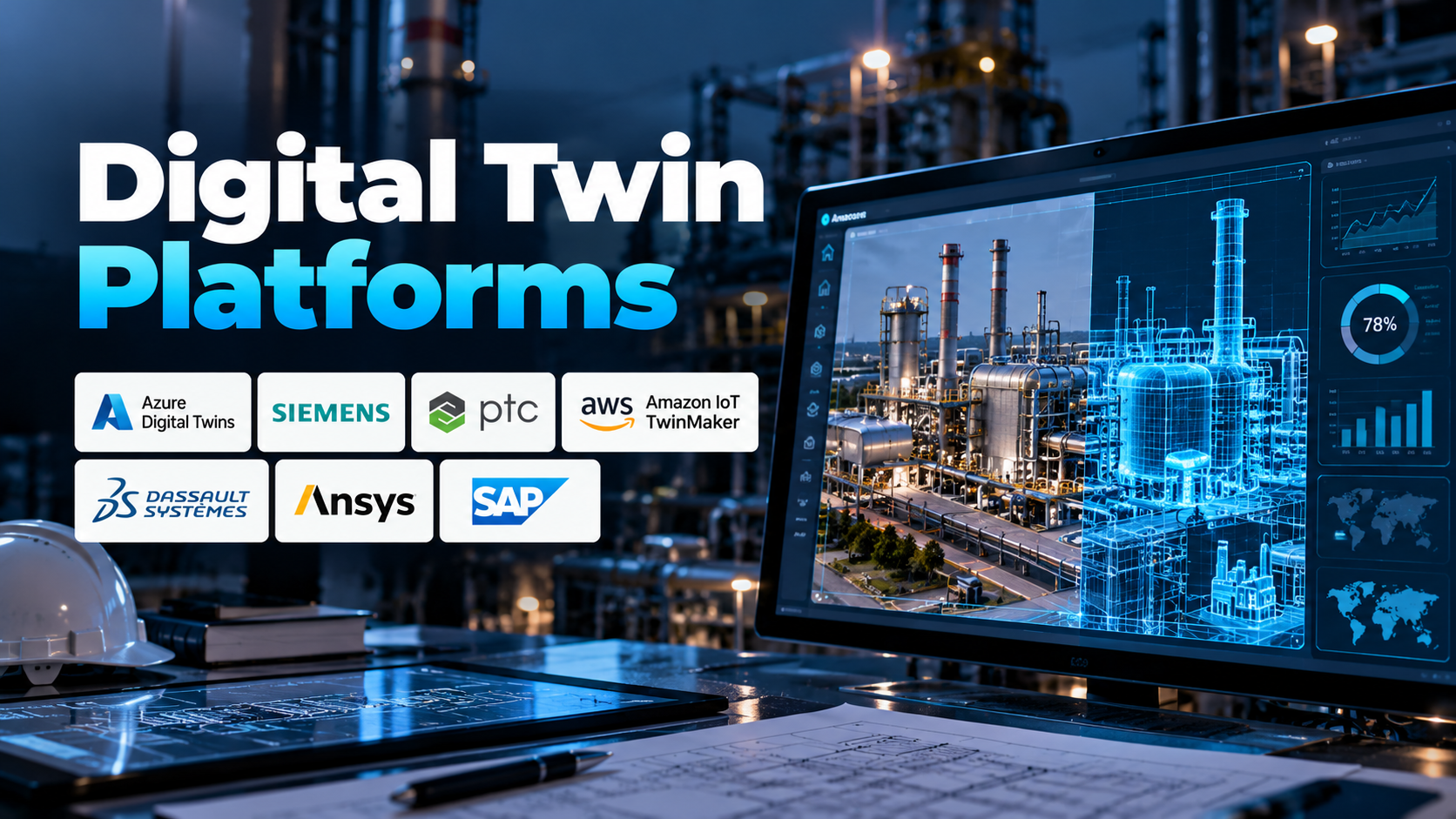
Digital twin platforms are transforming how organizations design, monitor, and maintain physical assets. By creating digital representations of real-world machines, buildings, industrial facilities, and entire production systems, these platforms help businesses understand how their assets behave and make better operational decisions.
From predicting equipment failures to optimizing energy consumption, digital twins bring together engineering models, sensor data, analytics, and visualization. They are increasingly used in manufacturing, healthcare, construction, energy, transportation, and smart infrastructure.
However, a digital twin is more than a three-dimensional model. Its real value comes from connecting a digital representation to relevant data from the physical asset and keeping that representation useful throughout the asset’s lifecycle.
Table of Contents
- What Are Digital Twin Platforms?
- How Digital Twin Platforms Work
- Key Features of Digital Twin Software
- Popular Digital Twin Platforms
- Applications Across Industries
- Benefits and Challenges
- How to Choose the Right Platform
- Frequently Asked Questions
1. What Are Digital Twin Platforms?
A digital twin platform is a software environment used to create, connect, manage, and analyze digital representations of physical objects, processes, or systems.
A digital twin may represent a single electric motor, an industrial production line, a commercial building, or a complete manufacturing facility. Depending on the application, it may combine engineering data, sensor readings, operational records, simulations, and historical information.
For example, an industrial motor can be represented digitally using its design specifications, operating temperature, vibration readings, rotational speed, and maintenance history. By analyzing these inputs, engineers may identify abnormal operating patterns and investigate potential maintenance needs.
Digital twins differ from conventional computer-aided design (CAD) models because they can incorporate information about actual operating conditions. They also differ from basic dashboards: a dashboard primarily displays information, while a digital twin can connect that information to an asset model, its relationships, and, in advanced applications, simulations or predictive analytics.
Not every digital twin updates continuously or supports predictive capabilities. These functions depend on the platform, data availability, integration, and models used.
2. How Digital Twin Platforms Work
Digital twin systems typically connect physical assets with digital models through several components.
Physical asset: This is the real-world object or process being represented, such as a turbine, machine tool, building, vehicle, or power system.
Data collection: Sensors, industrial controllers, connected devices, and enterprise systems supply information about the asset. Data may include temperature, pressure, vibration, energy consumption, operating status, or production output.
Connectivity and integration: Communication protocols, gateways, APIs, and data pipelines transfer information between systems. The exact integration requirements depend on the equipment and existing infrastructure.
Digital representation: The platform organizes the asset’s properties, structure, relationships, and relevant engineering information. Some twins include 3D visualization, while others use diagrams, graphs, tables, or mathematical models.
Analytics and simulation: Rules, statistical methods, machine learning, or physics-based simulations can help identify anomalies, estimate future behavior, and evaluate possible operating changes.
Visualization and action: Engineers and operators use dashboards, alerts, reports, and model views to understand asset conditions. In some applications, the insights inform maintenance planning or controlled changes to physical operations.
A digital twin can range from a simple connected asset model to a sophisticated simulation linked to real-time operational data. The appropriate level of complexity depends on the problem being solved.
3. Key Features of Digital Twin Software
Digital twin platforms offer different combinations of capabilities, but several features are especially important.
- Real-time or periodic data integration: Connects the digital representation to current or regularly updated information from physical assets.
- 3D visualization: Helps users understand the geometry, configuration, and spatial relationships of equipment or infrastructure.
- Asset modeling: Represents asset properties, components, dependencies, and relationships between systems.
- Simulation and engineering analysis: Evaluates how a system may behave under different operating conditions using suitable models.
- Predictive analytics: Uses historical and operational data to estimate equipment degradation, detect unusual behavior, or support maintenance decisions.
- AI and machine learning: Can help identify patterns, classify operating conditions, and generate forecasts when sufficient suitable data is available.
- Lifecycle management: Connects design, commissioning, operation, maintenance, and asset-performance information.
- Alerts and monitoring: Highlights abnormal readings, threshold violations, and conditions requiring investigation.
- Integration with enterprise systems: Connects digital twins to maintenance-management platforms, manufacturing systems, cloud services, and other operational applications.
A platform does not need every feature to deliver value. For instance, a building energy twin may focus on occupancy, HVAC performance, and energy consumption, while an aircraft-engine twin may require specialized physics-based models and detailed engineering data.
4. Popular Digital Twin Platforms
Digital twin solutions vary considerably in their focus. Some emphasize industrial engineering and simulation, while others provide cloud infrastructure, asset modeling, or integration with enterprise systems.
Microsoft Azure Digital Twins
Microsoft Azure Digital Twins is a platform for creating digital representations of physical environments using models, relationships, and live data integrations. It is relevant to applications such as connected buildings, industrial environments, and spatial or operational modeling.
Organizations evaluating it should consider the wider Azure ecosystem and verify current service availability, supported integrations, and architecture requirements before beginning a new deployment.
AWS IoT TwinMaker
AWS IoT TwinMaker helps developers create digital twins of real-world systems using data from multiple sources. It supports the integration of asset information and operational data to build contextualized digital representations.
It can be useful for teams already working with AWS services and seeking to connect industrial data with visualizations and operational applications.
Siemens Digital Twin Solutions
Siemens provides digital twin technologies across product engineering, manufacturing, automation, and industrial operations. Its portfolio connects engineering models, simulation, and production-related information to support different stages of an asset’s lifecycle.
These solutions are especially relevant to organizations seeking to connect product development with manufacturing and industrial engineering workflows.
PTC ThingWorx and Creo
PTC offers technologies spanning industrial IoT applications, product design, and engineering workflows. ThingWorx supports industrial connectivity and application development, while Creo provides 3D CAD and related product engineering capabilities.
When combined appropriately with operational data and models, these technologies can contribute to digital twin applications involving product performance, service, and industrial operations.
Dassault Systèmes 3DEXPERIENCE
Dassault Systèmes provides engineering, simulation, product lifecycle management, and virtual-twin capabilities through its software portfolio. Its solutions support the development and analysis of complex products, production systems, and industrial environments.
It is worth considering when a digital twin initiative requires close coordination between engineering design, simulation, and lifecycle information.
Ansys Digital Twin Technologies
Ansys provides simulation and engineering analysis technologies that can support digital twin applications. Its tools are relevant when understanding physical behavior—such as structural response, thermal performance, fluid flow, or electronic-system behavior—is central to the use case.
These capabilities can help connect engineering models with operational data, depending on the chosen products and integration architecture.
SAP Digital Twin Capabilities
SAP supports digital twin use cases through its enterprise software and asset-management ecosystem. Its technologies can help connect asset information with business processes, maintenance planning, supply chain activities, and product lifecycle data.
The suitability of an SAP-based approach depends on the organization’s existing systems and the specific operational or product information that needs to be connected.
These platforms are not direct substitutes for one another. Some concentrate on cloud-based twin modeling, while others specialize in simulation, industrial connectivity, engineering design, or enterprise lifecycle management.
5. Applications Across Industries
Manufacturing and Industrial Automation
Manufacturers can create digital representations of production lines, machines, and factory systems. By combining operational data with engineering information, teams can investigate bottlenecks, monitor equipment behavior, and improve production planning.
A digital twin of a manufacturing line may help engineers evaluate how a change in machine speed affects throughput or how equipment downtime influences the overall process.
Predictive Maintenance
Digital twins can support maintenance strategies by connecting asset condition data with engineering models and historical failure information.
For example, vibration and temperature readings from a motor may be compared with expected operating behavior. An analytical model can flag unusual patterns for further inspection, helping maintenance teams prioritize investigations.
Such systems do not guarantee that failures will be predicted accurately. Results depend on sensor quality, model suitability, operating conditions, and the availability of representative data.
Energy and Utilities
Power plants, electrical substations, renewable energy installations, and utility networks can benefit from digital representations of equipment and infrastructure.
Applications include equipment monitoring, performance analysis, maintenance planning, and evaluating operating scenarios. For renewable energy systems, digital models can also help teams investigate the relationship between environmental conditions and equipment performance.
Buildings and Smart Infrastructure
Digital twins of buildings can combine architectural models with information about occupancy, lighting, ventilation, energy use, and building-management systems.
Facility managers may use these representations to investigate inefficient energy consumption, monitor equipment, and plan maintenance. At city scale, digital twins can help represent transport systems, utilities, and urban infrastructure, although integrating data across many systems introduces additional complexity.
Healthcare and Medical Engineering
Digital twin concepts can be applied to medical devices, hospital operations, and selected physiological modeling research. These applications may support equipment monitoring, workflow analysis, or investigation of possible treatment scenarios.
A model should not be assumed to reproduce an individual patient’s condition accurately without appropriate clinical validation, data quality, and safeguards.
Automotive and Aerospace
Digital twins can support product development, simulation, manufacturing, and in-service asset monitoring. Engineers may use digital representations to study performance, investigate operating conditions, and improve maintenance planning.
In safety-critical industries, these applications require careful validation and must operate within the relevant engineering, regulatory, and safety processes.
6. Benefits and Challenges
Digital twin platforms can improve visibility into asset performance by bringing together information that would otherwise remain scattered across sensors, engineering files, and business systems. They can support more informed maintenance decisions, reduce time spent investigating operational problems, and help teams evaluate changes before applying them to physical systems.
Simulation can also reduce the need for some physical experiments during design and optimization, although physical testing remains necessary where required to validate performance and safety.
Despite these advantages, implementation involves several challenges.
Data quality: Missing, inaccurate, or inconsistent data can make the digital representation unreliable.
Integration complexity: Industrial environments often contain legacy equipment, different communication protocols, and disconnected information systems.
Implementation cost: Sensors, connectivity, cloud services, modeling, software licensing, and specialist expertise can all contribute to project costs.
Model accuracy: A digital twin is only as useful as the assumptions, data, and models supporting it. Physical systems may behave differently from simplified simulations.
Cybersecurity and privacy: Connecting operational assets to networks introduces security considerations, especially in critical infrastructure and industrial control environments.
Skills and maintenance: Models and integrations require ongoing updates as equipment, software, processes, and operating conditions change.
Successful deployments generally begin with a clearly defined operational problem instead of attempting to create a comprehensive digital representation of an entire organization immediately.
7. How to Choose the Right Platform
The best digital twin platform depends on the asset being modeled, the decisions the twin needs to support, and the organization’s existing technology environment.
For industrial IoT and monitoring: Prioritize reliable connectivity, time-series data integration, asset modeling, alerts, and compatibility with existing industrial systems.
For engineering and simulation: Look for suitable physics-based simulation, CAD integration, model validation, and the ability to connect engineering results with operating data.
For buildings and infrastructure: Consider spatial modeling, building-management integrations, asset relationships, energy monitoring, and lifecycle information.
For enterprise asset management: Evaluate integration with maintenance workflows, enterprise resource planning, asset records, and operational reporting.
For AI-driven predictive maintenance: Examine data availability, model development tools, explainability, monitoring, and the ability to validate predictions against real operating outcomes.
Before selecting a platform, define the use case, identify required data sources, establish measurable success criteria, and test the proposed solution on a representative asset or process.
For example, a pilot project might measure whether the twin improves fault detection, reduces the time required to investigate an abnormal condition, or provides more accurate energy-consumption analysis. These measurable outcomes help determine whether a larger deployment is justified.
8. Frequently Asked Questions
Is a digital twin the same as a 3D model?
No. A 3D model represents an object’s geometry, while a digital twin can also incorporate operating data, asset relationships, analytics, and simulation. Some digital twins use 3D visualization, but it is not essential.
What is the difference between a digital twin and a simulation?
A simulation evaluates the behavior of a system using a model and defined conditions. A digital twin connects a digital representation to information about a physical asset or process and may use simulations as one of its capabilities.
Do digital twins require real-time data?
Not always. Some applications use continuous data feeds, while others update periodically or rely on historical information. The update frequency should match the decisions the digital twin is intended to support.
Which industries benefit most from digital twins?
Manufacturing, energy, utilities, construction, transportation, and aerospace are important application areas. The greatest value usually occurs when assets are complex, operational data is available, and better decisions can meaningfully improve cost, performance, reliability, or safety.
Are digital twin platforms suitable for small businesses?
Yes, depending on the use case. A small business may begin with a limited asset model and a few relevant data sources. Starting small can make it easier to assess costs, demonstrate value, and expand only when the benefits justify further investment.
Conclusion
Digital twin platforms connect physical assets with digital models, operational data, engineering knowledge, and analytical capabilities. They help organizations understand how systems behave, investigate potential problems, and make more informed decisions throughout an asset’s lifecycle.
The most effective digital twin is not necessarily the most visually sophisticated or technologically complex. It is the one that represents the right asset accurately, uses trustworthy data, integrates with existing workflows, and supports a clearly defined operational goal. By beginning with a focused use case and validating results carefully, organizations can build digital twin solutions that deliver practical value rather than complexity for its own sake.