Table of Contents
- Introduction to Digital Experience Platforms
- What Is a Digital Experience Platform?
- Why Businesses Need a DXP
- How a DXP Works
- Key Components of a DXP
- Types of Digital Experience Platforms
- Essential Features of DXP Software
- Popular Digital Experience Platform Examples
- DXP vs. CMS vs. CRM vs. CDP
- Benefits of Implementing a DXP
- Common Use Cases Across Industries
- DXP Architecture: Traditional, Headless, and Composable
- Personalization, AI, and Customer Journey Optimization
- Challenges and Limitations of DXP Software
- How to Choose the Right DXP
- DXP Implementation Best Practices
- Measuring DXP Performance and ROI
- The Future of Digital Experience Platforms
- Frequently Asked Questions
- Conclusion
1. Introduction to Digital Experience Platforms
Modern customers interact with businesses through numerous digital channels. They may discover a brand through a search engine, browse its website, compare products on a mobile application, receive a promotional email, contact customer support, and eventually complete a purchase through an online store.
Customers expect these interactions to be consistent, relevant, convenient, and connected. However, businesses often manage their websites, customer information, marketing campaigns, online stores, and analytics through separate systems.
This fragmentation creates problems. Customers may receive irrelevant offers, encounter inconsistent information, repeat details they have already provided, or experience different levels of service across channels.
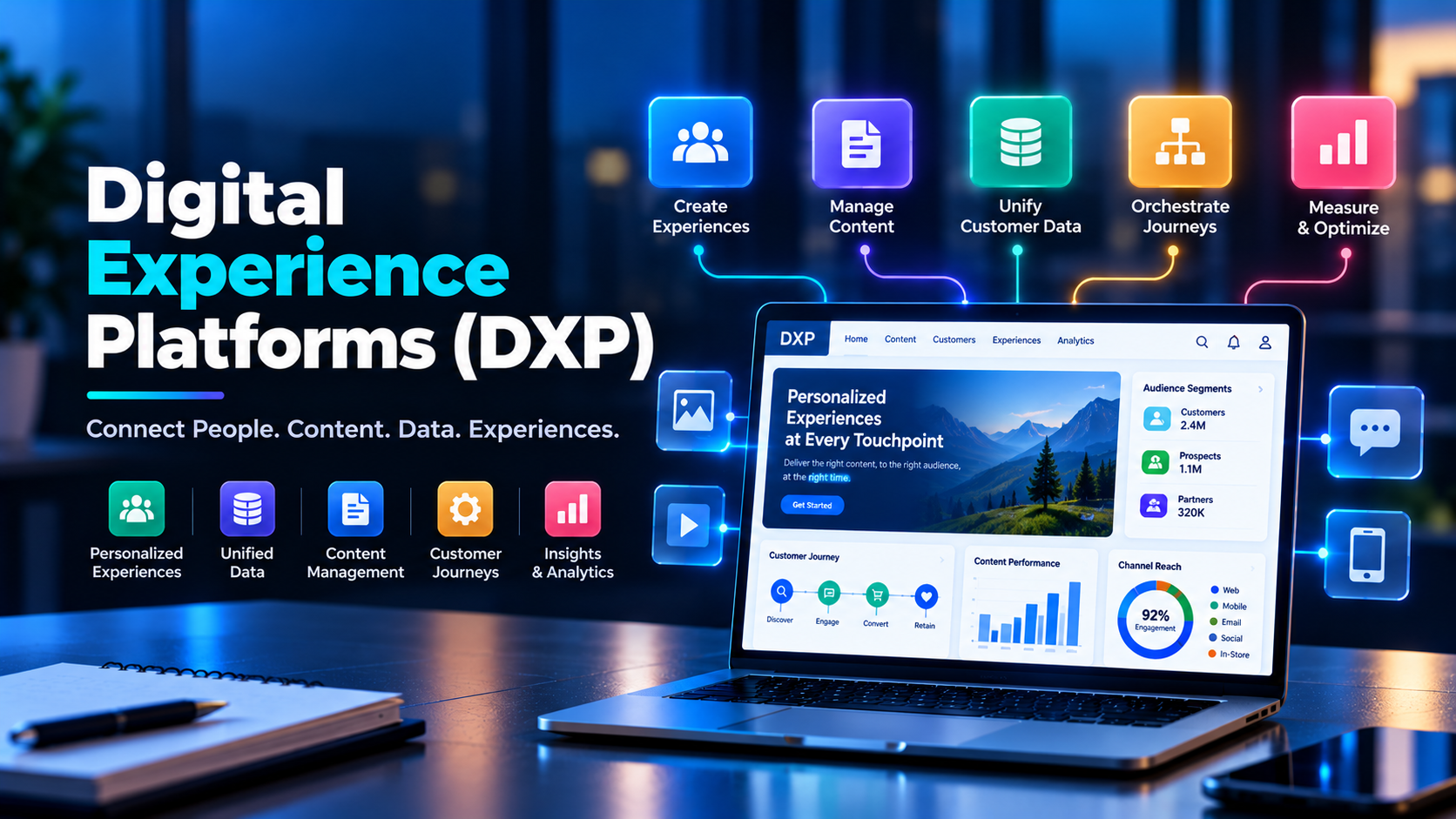
A Digital Experience Platform (DXP) addresses this challenge by connecting the technologies businesses use to create, manage, deliver, personalize, and optimize digital experiences.
Rather than focusing only on publishing website content, a DXP can combine content management, customer data, personalization, analytics, search, commerce, and integrations to coordinate interactions across multiple digital touchpoints.
For example, an online retailer can use a DXP to display relevant product content, personalize landing pages, coordinate promotions, measure customer engagement, and improve the shopping journey.
Similarly, a university can use a DXP to manage its public website, student portal, course information, application journey, and personalized communications.
DXPs are particularly valuable for organizations that need to manage complex digital experiences across multiple audiences, brands, regions, products, and channels.
2. What Is a Digital Experience Platform?
A Digital Experience Platform is an integrated set of technologies that helps an organization create, manage, deliver, and continuously improve digital experiences across websites, mobile applications, customer portals, e-commerce platforms, and other digital channels.
A DXP connects content with customer information, business applications, and optimization tools so that interactions can be coordinated rather than managed independently.
Its exact capabilities depend on the vendor and architecture. Some platforms provide a broad suite of integrated features, while others allow businesses to assemble a customized ecosystem from specialized products connected through APIs.
A simple example
Imagine an online fashion retailer with the following systems:
- A website for displaying products.
- A content management system for publishing articles.
- A customer relationship management system for maintaining customer records.
- An email marketing tool for sending campaigns.
- An analytics platform for tracking website activity.
- An e-commerce system for processing orders.
If these tools operate independently, the marketing team may struggle to understand which content influences purchases or which products are relevant to different customer groups.
A DXP-oriented architecture connects these capabilities so the business can coordinate content, customer data, commerce, and analytics.
A returning visitor might see product recommendations based on permitted customer information and previous interactions. The business can then measure whether those recommendations improve engagement or sales.
The key idea: A CMS primarily manages content, while a DXP connects content management with the wider technologies and processes needed to deliver and improve digital experiences.
A DXP does not necessarily replace every existing business application. It often acts as an integration and orchestration layer across several systems.
3. Why Businesses Need a DXP
Businesses increasingly compete on the quality of their digital experiences, not just on their products or prices.
A confusing website, disconnected customer journey, or irrelevant message can cause customers to abandon a transaction or choose another provider.
DXPs help address several common challenges.
3.1 Fragmented customer experiences
When departments use disconnected tools, customers may receive inconsistent information across websites, emails, applications, and support channels.
A DXP helps coordinate content and interactions across these touchpoints.
3.2 Disconnected customer data
Customer information may be distributed across marketing platforms, CRM systems, commerce applications, and analytics tools.
A DXP can connect relevant data sources to improve audience understanding and experience delivery, subject to the organization’s data architecture and privacy policies.
3.3 Slow content publishing
Large organizations often require multiple approvals before publishing content. Without structured workflows, teams can struggle with duplicated work, outdated information, and delays.
DXPs can provide reusable content, approval workflows, version management, and centralized governance.
3.4 Limited personalization
A generic website may show the same content to every visitor even when their interests, needs, or stages in the buying journey differ.
Personalization capabilities can adapt supported content and recommendations according to defined audience rules and available data.
3.5 Difficulty measuring performance
A business may know how many people visited its website without understanding which interactions contributed to meaningful outcomes.
DXP analytics and experimentation capabilities help teams evaluate content, customer journeys, conversions, and engagement.
3.6 Increasing digital complexity
Organizations may operate several brands, languages, websites, applications, and customer portals. A DXP can provide shared capabilities and governance while supporting different experiences for different audiences.
The main objective is to make digital experiences more connected, manageable, measurable, and adaptable.
4. How a DXP Works
A DXP brings together several technologies and workflows to manage digital experiences from creation through delivery and optimization.
Step 1: Content is created
Content teams develop website pages, product descriptions, articles, images, videos, landing pages, and other digital materials.
The content is stored in a content management system or another connected repository.
Step 2: Content is organized and approved
Editors classify content, apply metadata, select approved assets, and send material through review workflows.
Permissions and governance rules help ensure that only authorized users publish or modify content.
Step 3: Customer information is connected
The platform may receive relevant information from CRM systems, customer data platforms, commerce applications, analytics tools, and other approved sources.
This information can help businesses understand audience segments and customer interactions.
Step 4: Experiences are assembled
The DXP combines content, templates, design components, data, and application services to create a digital experience.
Depending on the architecture, the experience may be delivered through a traditional website, a headless front end, a mobile application, or another supported channel.
Step 5: Personalization rules are applied
The platform may select content based on audience segments, previous interactions, location, preferences, or other permitted signals.
For example, a returning customer may receive recommendations relevant to their browsing history, provided the necessary data and permissions are available.
Step 6: The experience is delivered
The content and functionality are presented through the relevant digital channel, such as a website, customer portal, or mobile application.
APIs and integrations help different systems exchange the information required to complete the interaction.
Step 7: Performance is measured
Analytics tools measure relevant activity, including page views, engagement, conversions, search behavior, and customer journey outcomes.
Step 8: The experience is improved
Teams use performance data, customer feedback, and controlled experiments to improve content, navigation, recommendations, and conversion processes.
This creates a continuous improvement cycle: create, deliver, measure, learn, and optimize.
5. Key Components of a DXP
A DXP is an ecosystem rather than a single mandatory collection of features. The components included depend on the business requirements and selected architecture.
5.1 Content Management System (CMS)
The CMS is often the foundation of a DXP.
It enables teams to create, edit, organize, approve, and publish digital content without requiring developers to manually update every page.
Common capabilities include:
- Page and content editing.
- Templates and reusable components.
- Version control.
- Publishing workflows.
- Multilingual content management.
- Multi-site administration.
5.2 Digital Asset Management (DAM)
DAM software manages digital assets such as photographs, videos, illustrations, documents, logos, and campaign materials.
It helps teams find approved assets, manage metadata, track versions, and reuse content across multiple channels.
5.3 Customer Relationship Management (CRM)
CRM systems manage information about customers, prospects, sales activities, interactions, and business relationships.
A DXP may integrate with a CRM to coordinate website experiences, customer communications, and sales-related interactions.
5.4 Customer Data Platform (CDP)
A CDP collects and organizes customer information from supported sources to create more unified customer profiles.
When integrated with a DXP, it can help deliver audience segmentation and personalization.
A DXP does not automatically include a full CDP; the capabilities may be provided by a separate product.
5.5 Personalization engine
Personalization tools determine which content, recommendations, messages, or experiences should be presented to particular users or audience segments.
Rules may be based on declared preferences, customer attributes, behavior, or other approved signals.
5.6 Analytics and experimentation
Analytics tools measure how people interact with digital experiences.
Experimentation features, such as A/B testing, allow teams to compare alternative page designs, messages, or experiences to determine which performs better.
5.7 Search and navigation
Search capabilities help users find products, articles, services, documents, and other information.
Advanced implementations may include filtering, relevance tuning, recommendations, and personalized discovery.
5.8 E-commerce and transactional services
For retail and service businesses, a DXP may integrate with product catalogs, pricing systems, shopping carts, payment workflows, and order management platforms.
These integrations connect content and marketing experiences with purchasing activities.
5.9 Integration and API management
APIs enable the DXP to communicate with other applications.
Integration capabilities help businesses connect customer data, inventory, search, commerce, identity systems, and marketing automation tools.
5.10 Security and governance
Security controls manage authentication, user roles, permissions, publishing approvals, and administrative access.
Governance policies help maintain consistent content standards, brand guidelines, privacy practices, and compliance requirements.
6. Types of Digital Experience Platforms
DXPs can be classified according to the business audiences they serve and how their technology is structured.
6.1 Customer-facing DXP
Customer-facing platforms focus on interactions between a business and its customers.
Typical applications include marketing websites, product discovery, online shopping, customer support, and personalized content.
Best suited for: Retailers, financial services, telecommunications companies, travel businesses, and consumer brands.
6.2 Business-to-business (B2B) DXP
B2B platforms support interactions between businesses, distributors, suppliers, and corporate buyers.
Features may include customer-specific catalogs, account portals, quotation workflows, partner resources, and role-based pricing.
Best suited for: Manufacturers, wholesalers, distributors, and enterprise service providers.
6.3 Employee-facing DXP
Employee-facing platforms support internal digital experiences such as employee portals, knowledge hubs, internal communications, and self-service resources.
They can connect content, applications, and employee information in one accessible environment.
Best suited for: Large enterprises, universities, public-sector organizations, and distributed workforces.
6.4 Commerce-focused DXP
Commerce-focused platforms combine digital content and marketing experiences with product discovery, transactions, and customer engagement.
They may integrate catalog management, search, recommendations, checkout, and order services.
Best suited for: E-commerce retailers and organizations with complex digital purchasing journeys.
6.5 Composable DXP
A composable DXP uses modular components that can be selected, replaced, and connected according to business needs.
For example, a company might use one vendor for content management, another for personalization, a third for search, and a separate analytics platform.
Best suited for: Organizations that need architectural flexibility and have the technical resources to integrate multiple products.
6.6 Suite-based or traditional DXP
A suite-based DXP provides multiple capabilities within a more integrated platform, often under a common vendor.
This can simplify administration and integration, although organizations should evaluate licensing, customization, upgrade complexity, and dependence on the vendor.
Best suited for: Organizations that prefer a unified environment and need several capabilities managed together.
7. Essential Features of DXP Software
When evaluating DXP products, focus on capabilities that support your specific business objectives.
Omnichannel content delivery
Content should be reusable across websites, mobile applications, portals, and other supported channels.
Visual content editing
Non-technical teams should be able to create and update content efficiently through suitable editing interfaces.
Personalization and segmentation
The platform should support the audience rules and data sources required to deliver relevant experiences.
Workflow automation
Approval processes, scheduled publishing, content reviews, and notifications can reduce manual work.
Analytics and reporting
Teams should be able to evaluate engagement, conversions, content performance, and other business-relevant metrics.
A/B testing
Experimentation capabilities help compare different experiences and support evidence-based decisions.
API and integration support
The platform should connect with the organization’s existing applications, identity systems, analytics, commerce, and customer data tools.
Scalability and performance
The solution should support expected traffic, content volumes, geographic reach, and business growth.
Multilingual and multisite support
International organizations may need to manage multiple languages, regional websites, local permissions, and market-specific content.
Security and access management
Look for role-based access, secure authentication, audit capabilities, and appropriate administrative controls.
Accessibility
Content editors and developers should be able to create experiences that are usable by people with different abilities and assistive technologies.
AI-assisted capabilities
Some DXPs offer AI-assisted content creation, tagging, recommendations, search, or optimization. Evaluate the quality, governance, privacy, and human-review requirements of these features rather than assuming that AI automatically improves results.
8. Popular Digital Experience Platform Examples
Several vendors offer DXP products or technologies that can form part of a DXP architecture. Their capabilities, packaging, and licensing vary.
8.1 Adobe Experience Manager
Adobe Experience Manager combines enterprise content management capabilities with digital asset management and broader Adobe experience technologies.
It can be useful for organizations managing large websites, complex content operations, multiple brands, and extensive digital asset libraries.
Consider it when: You need enterprise-scale content operations and integration with other Adobe experience or creative tools.
8.2 Sitecore
Sitecore provides digital experience technologies covering content management and, depending on the product configuration, personalization, customer data, and marketing-related capabilities.
Consider it when: You need sophisticated content delivery, personalized customer journeys, and integration across digital marketing workflows.
8.3 Optimizely
Optimizely offers digital experience technologies that include content management and experimentation-related capabilities.
Its ecosystem can support teams that want to create content, test alternative experiences, and optimize digital performance.
Consider it when: Experimentation and continuous optimization are central to your digital strategy.
8.4 Liferay DXP
Liferay DXP focuses on digital experiences such as enterprise portals, customer self-service, partner portals, and employee-facing applications.
It can be particularly relevant when access to business services and information must be organized around user roles.
Consider it when: Your organization needs portals, authenticated experiences, or complex enterprise integrations.
8.5 Acquia
Acquia provides digital experience technologies built around Drupal and related enterprise capabilities.
It can support content management, digital asset workflows, personalization, and connected digital experiences, depending on the selected products.
Consider it when: You want a Drupal-oriented content ecosystem with enterprise support and integration options.
8.6 Contentful
Contentful is known for its API-first content platform, which enables teams to manage structured content and deliver it to multiple digital channels.
It is commonly associated with headless and composable content architectures.
Consider it when: You want developers to build custom front ends while content teams manage reusable content independently.
8.7 Contentstack
Contentstack provides a headless content management platform designed for API-driven content delivery and composable digital architectures.
Consider it when: You want structured content management and integration with specialized marketing, commerce, or analytics tools.
8.8 Magnolia
Magnolia offers digital experience and content management technologies with options for integrating different systems and supporting enterprise content workflows.
Consider it when: Your organization needs flexible content management across multiple sites, brands, or digital channels.
How to compare DXP vendors
Do not assume every vendor offers the same capabilities in every edition. Evaluate:
- Required features and licensing tiers.
- Ease of use for content teams.
- Developer experience and customization.
- Personalization and experimentation capabilities.
- API coverage and integration effort.
- Hosting, performance, and scalability.
- Security and governance.
- Implementation partners and support.
- Migration costs and long-term flexibility.
A proof of concept using representative business scenarios is often the best way to validate whether a platform fits your needs.
9. DXP vs. CMS vs. CRM vs. CDP
These systems work together, but they have different primary purposes.
| Technology | Primary purpose | Example |
|---|---|---|
| DXP | Connect and optimize digital experiences across channels | Delivering coordinated website, portal, and personalized content experiences |
| CMS | Create, manage, and publish content | Updating product pages and blog articles |
| CRM | Manage customer relationships and sales interactions | Maintaining contact records and tracking sales opportunities |
| CDP | Unify customer data from supported sources | Building customer profiles for audience segmentation |
| DAM | Organize and distribute digital assets | Finding approved product photographs and campaign videos |
| Marketing automation | Automate marketing communications and workflows | Sending scheduled email campaigns |
| Analytics platform | Measure user behavior and performance | Reporting traffic, engagement, and conversions |
DXP vs. CMS
A CMS focuses on managing content. A DXP extends the scope by connecting content with personalization, customer data, analytics, integrations, and other digital experience capabilities.
A business with a simple website may need only a CMS. A company managing many digital channels and customer journeys may benefit from a broader DXP.
DXP vs. CRM
A CRM focuses on customer relationships, contact information, sales processes, and related interactions.
A DXP focuses on delivering digital experiences. It may use CRM data to personalize a website or connect a digital interaction with a customer relationship workflow.
DXP vs. CDP
A CDP focuses on collecting and organizing customer data from supported sources.
A DXP can use customer data to select content and coordinate experiences. The two technologies are complementary rather than interchangeable.
DXP vs. marketing automation
Marketing automation coordinates tasks such as campaign scheduling, email sequences, and lead nurturing.
A DXP may integrate with marketing automation to coordinate content and interactions across broader digital journeys.
Practical takeaway: Businesses do not always need to replace their existing systems with one DXP. In many cases, the best solution is to connect the right technologies through a well-designed architecture.
10. Benefits of Implementing a DXP
More consistent customer experiences
Shared content, data, and integration capabilities help maintain consistency across supported channels.
Improved personalization
Connected customer information and personalization tools can make content and recommendations more relevant to users.
Faster content operations
Reusable components, templates, workflows, and centralized governance can reduce duplicated effort.
Better collaboration
Marketing, content, design, IT, analytics, and commerce teams can work within a more coordinated process.
Improved decision-making
Analytics and experimentation help teams understand which content and interactions contribute to business outcomes.
Greater scalability
A suitable DXP architecture can support additional websites, markets, languages, channels, and business requirements.
More efficient technology integration
A DXP can connect existing business systems and reduce the need for isolated, manually maintained processes.
Stronger brand governance
Centralized templates, approved assets, and publishing permissions can help organizations maintain consistent brand standards.
Potential improvements in conversion and retention
Relevant content, smoother journeys, and better navigation may improve conversions and customer retention. The actual results depend on execution and should be measured rather than assumed.
Better employee and partner experiences
DXPs can also support internal portals and business-to-business interactions, helping employees and partners find information and complete tasks more efficiently.
11. Common Use Cases Across Industries
E-commerce and retail
A retailer can use a DXP to coordinate product content, category pages, customer recommendations, promotional campaigns, and online shopping journeys.
For example, a returning visitor might see relevant categories and product recommendations based on permitted preference data.
Banking and financial services
Financial institutions can use digital experience technologies to manage public websites, customer portals, educational content, and authenticated service journeys.
Security, accessibility, privacy, and regulatory governance are particularly important in this industry.
Education
Universities and training providers can use DXPs to manage course information, admission pages, student portals, event content, and personalized communications.
A prospective student might discover a program, review entry requirements, submit an application, and receive relevant updates through connected digital touchpoints.
Healthcare
Healthcare organizations can coordinate public information, patient portals, appointment-related content, and service information.
Any personalization involving sensitive health information requires appropriate privacy protections, access controls, and careful data governance.
Travel and hospitality
Hotels, airlines, and travel businesses can use DXPs to connect destination content, booking experiences, loyalty programs, and customer communications.
The goal is to make the journey from research to booking and post-purchase support more consistent.
Manufacturing and B2B services
Manufacturers can create customer and distributor portals, technical documentation libraries, product catalogs, and account-specific experiences.
Media and publishing
Publishers can manage editorial content, subscriptions, digital assets, audience experiences, and content distribution across websites and applications.
Government and public services
Public-sector organizations can use DXPs to provide service information, application portals, forms, and accessible digital services.
The platform must support relevant privacy, accessibility, records-management, and security requirements.
Enterprise employee portals
Organizations can bring internal news, policies, training resources, business applications, and employee self-service tools into a connected digital environment.
12. DXP Architecture: Traditional, Headless, and Composable
The architecture determines how the platform’s components are organized and how content reaches users.
12.1 Traditional or suite-based architecture
A traditional DXP combines several capabilities in a tightly integrated platform.
Advantages:
- Shared administration and governance.
- Integrated workflows.
- Fewer separate systems to manage.
- Potentially simpler coordination between components.
Limitations:
- Greater dependence on a single vendor.
- Customization may be complex.
- Upgrades may affect multiple components.
- The organization may pay for capabilities it does not need.
This approach can work well when the platform closely matches the organization’s requirements.
12.2 Headless architecture
In a headless content architecture, the content management back end is separated from the front-end presentation layer.
Content is delivered through APIs to websites, mobile applications, digital kiosks, and other supported interfaces.
Example: A business manages product descriptions in one content system and delivers them to both its website and mobile application.
Advantages:
- Flexible front-end development.
- Content reuse across channels.
- Greater freedom in presentation technology.
- Independent development of supported experiences.
Limitations:
- Requires suitable technical expertise.
- Preview and editing workflows may need additional configuration.
- Integrations and front-end applications require maintenance.
Headless CMS is an architectural approach that can be part of a DXP; it is not automatically a complete DXP on its own.
12.3 Composable DXP
A composable DXP is assembled from modular components that communicate through APIs and other integration mechanisms.
A business might combine:
- A headless CMS for content.
- A DAM for digital assets.
- A CDP for customer profiles.
- A personalization service.
- A commerce engine.
- An analytics platform.
Advantages:
- Greater flexibility in choosing technologies.
- Components can evolve independently.
- Organizations can select specialized tools.
- New services can be added as needs change.
Limitations:
- Integration complexity.
- Multiple vendor relationships.
- More responsibility for system architecture.
- Potentially fragmented support and monitoring.
Which architecture should you choose?
A suite-based DXP may be suitable when integration and centralized management are priorities. A composable architecture may be better when flexibility and specialized capabilities are more important.
The decision should reflect technical maturity, budget, business complexity, integration requirements, and long-term maintenance capacity.
13. Personalization, AI, and Customer Journey Optimization
Modern DXP strategies increasingly focus on using data and automation to improve digital experiences.
Personalization
Personalization adapts an experience to the needs or characteristics of an audience.
Examples include:
- Showing relevant content to different audience segments.
- Recommending products based on permitted behavioral signals.
- Displaying region-specific information.
- Tailoring messages to a customer’s stage in a journey.
- Adjusting content according to declared preferences.
Personalization should provide real value. Excessively intrusive targeting or unexplained use of personal information can reduce trust.
Artificial intelligence
AI capabilities may support:
- Content drafting and summarization.
- Metadata generation and tagging.
- Search relevance.
- Product and content recommendations.
- Audience segmentation.
- Predictive analytics.
- Automated content variations.
- Assistance with testing and optimization.
AI-generated material should be reviewed for accuracy, originality, brand consistency, accessibility, and compliance with relevant policies.
Customer journey optimization
Customer journey optimization examines how people move between digital touchpoints and where they encounter friction.
For example, an online education provider may discover that many visitors read a course page but abandon the application form. The team can test clearer entry requirements, shorter forms, or more visible calls to action.
The DXP provides part of the technology needed to coordinate the experience and measure results. Successful optimization still requires thoughtful research, good content, reliable data, and disciplined experimentation.
Privacy and responsible data use
Organizations should define what data they collect, why they collect it, how long it is retained, and which systems can access it.
Personalization must follow applicable privacy laws, consent requirements, organizational policies, and user expectations.
14. Challenges and Limitations of DXP Software
High implementation costs
Enterprise DXP projects can involve licensing, migration, integration, consulting, hosting, training, and ongoing maintenance.
Solution: Define the business case and prioritize the most valuable capabilities before expanding the scope.
Complex integrations
Connecting a DXP to legacy systems, customer databases, commerce tools, and analytics platforms can require significant development effort.
Solution: Document integration requirements and test critical data flows early.
Data quality problems
Personalization and analytics are only as useful as the underlying data. Duplicate records, inconsistent identifiers, missing information, and outdated content can reduce effectiveness.
Solution: Establish data ownership, validation rules, and governance processes.
Organizational resistance
Teams accustomed to their own tools may resist new workflows or centralized governance.
Solution: Involve stakeholders early, explain the benefits, and provide practical training.
Vendor lock-in
A tightly integrated platform can make future migrations or replacements difficult.
Solution: Evaluate export options, API coverage, contract terms, and the cost of switching before committing.
Overengineering
Some businesses purchase a complex DXP when a CMS and a few integrations would meet their needs.
Solution: Match the architecture to actual requirements rather than choosing the largest feature set.
Measurement difficulties
Changes in conversion rates or customer retention may be influenced by pricing, seasonality, campaigns, competition, and other factors.
Solution: Use clear baselines, controlled experiments where appropriate, and transparent reporting.
Privacy and security risks
A DXP may connect multiple systems containing customer or business information. Weak permissions, misconfigured integrations, or excessive data collection can create risk.
Solution: Apply least-privilege access, secure integrations, monitoring, privacy reviews, and regular testing.
15. How to Choose the Right DXP
Selecting a DXP is a strategic technology decision. Use a structured evaluation process.
Step 1: Define business objectives
Decide what you want to improve.
Examples include faster publishing, better online conversion, more consistent branding, improved customer self-service, or more efficient management of multiple websites.
Step 2: Map your digital touchpoints
List the channels and experiences you need to support, including websites, mobile applications, customer portals, commerce, and internal platforms.
Step 3: Assess your existing technology
Inventory your CMS, CRM, CDP, DAM, commerce, analytics, identity, and marketing automation systems.
Identify which capabilities should be retained, replaced, or integrated.
Step 4: Prioritize required features
Separate essential capabilities from optional features.
For example, a global retailer may prioritize multilingual content, commerce integration, personalization, and multisite governance. A university may prioritize student portals, accessibility, structured content, and application workflows.
Step 5: Evaluate architecture
Decide whether a suite-based, headless, composable, or hybrid approach fits your organization.
Consider your development resources and capacity to maintain integrations.
Step 6: Check integration and migration
Review API capabilities, identity integration, data migration, content modeling, and the effort needed to move existing websites and assets.
Step 7: Review security and governance
Evaluate authentication, role-based access, audit logging, data handling, privacy, backup, and recovery capabilities.
Step 8: Evaluate the user experience
Ask content editors, marketers, developers, and administrators to test the platform.
Check whether the interface supports their daily tasks without unnecessary complexity.
Step 9: Calculate total cost of ownership
Include subscriptions, implementation, integration, training, support, hosting, maintenance, and future migration.
Step 10: Run a pilot
Build a small but realistic experience, such as one campaign landing page, a limited customer portal, or a single regional website.
Use the pilot to validate performance, integrations, workflows, and measurable business value.
16. DXP Implementation Best Practices
A successful implementation depends on more than selecting the right software.
Start with a clear roadmap
Define the initial scope, business objectives, owners, milestones, and success metrics.
Avoid migrating unnecessary content
A platform migration is an opportunity to remove outdated pages, duplicate assets, and content that no longer serves a clear purpose.
Establish content governance
Define who can create, edit, approve, publish, and retire content.
Standardize metadata, templates, naming conventions, and accessibility practices.
Design for reuse
Create reusable components and structured content models to reduce duplication and make updates easier.
Integrate incrementally
Connect high-priority systems first, validate data flows, and expand gradually rather than attempting every integration at once.
Protect data and identities
Apply least privilege, secure authentication, clear data retention rules, and regular permission reviews.
Train all user groups
Content editors, developers, marketers, analysts, and administrators have different responsibilities. Training should reflect their actual workflows.
Establish performance baselines
Measure current publishing times, website performance, conversion rates, engagement, and operational costs before implementation.
Test accessibility and mobile usability
Check whether experiences work across relevant devices, screen sizes, browsers, and assistive technologies.
Continuously improve
Review analytics, user feedback, technical performance, and governance processes regularly. A DXP should evolve as business needs change.
17. Measuring DXP Performance and ROI
DXP performance should be assessed through business outcomes, user experience, and operational efficiency.
Customer experience metrics
- Customer satisfaction.
- Task completion rate.
- Digital self-service success.
- Repeat visits and retention.
- Search success and content engagement.
Marketing metrics
- Conversion rate.
- Campaign engagement.
- Qualified lead generation.
- Landing-page performance.
- Cost per acquisition, where relevant.
Content operations metrics
- Time required to publish content.
- Content reuse rate.
- Approval cycle duration.
- Number of outdated or duplicate pages.
- Effort required to maintain multiple websites.
Technical metrics
- Page load performance.
- Availability and reliability.
- API response times.
- Error rates.
- Successful integration transactions.
Illustrative ROI calculation
Suppose a business spends ₹20,00,000 annually on a DXP and its related operating costs.
After implementation, it estimates the following annual benefits:
- ₹8,00,000 saved through more efficient content operations.
- ₹7,00,000 in additional contribution from improved conversions.
- ₹5,00,000 saved through reduced manual maintenance.
Total estimated annual benefits: ₹20,00,000.
Using the simplified annual ROI formula:
ROI = (Benefits − Costs) ÷ Costs × 100
ROI = (₹20,00,000 − ₹20,00,000) ÷ ₹20,00,000 × 100
Illustrative annual ROI = 0%.
This example shows why businesses should calculate costs and benefits carefully rather than assuming that a DXP automatically produces positive returns.
Actual analysis should consider implementation costs, recurring expenses, attribution, uncertainty, the evaluation period, and benefits that may take time to materialize.
18. The Future of Digital Experience Platforms
DXPs are evolving alongside cloud computing, AI, API-driven architecture, and changing customer expectations.
AI-assisted experience management
AI is increasingly being applied to content creation, classification, search, personalization, and optimization. Human oversight remains important for accuracy, governance, and brand consistency.
Composable architectures
Organizations are increasingly evaluating modular systems that let them select specialized tools and connect them through APIs.
This approach can provide flexibility, although integration and maintenance responsibilities must be planned carefully.
Omnichannel delivery
Content is no longer limited to websites. Businesses may need to deliver information through applications, connected devices, digital kiosks, portals, and emerging interfaces.
Structured content and API-based delivery can support these requirements.
Real-time personalization
As suitable data and infrastructure become available, businesses can adapt supported experiences more quickly in response to user actions and context.
Responsible data use and transparent privacy practices remain essential.
Search and AI-driven discovery
Businesses need content that is well structured, accurate, accessible, and understandable across traditional search engines and newer AI-assisted discovery experiences.
DXPs can support content governance and structured delivery, but no platform can guarantee visibility in search results or AI-generated answers.
Privacy-first digital experiences
Organizations will need to balance relevant personalization with user choice, data minimization, consent, and secure handling of information.
Greater emphasis on measurable outcomes
DXP investment is likely to be evaluated increasingly through measurable customer experience, revenue contribution, publishing efficiency, and operational performance.
The most successful implementations will combine appropriate technology with clear strategy, good content, reliable data, and continuous improvement.
19. Frequently Asked Questions
What does DXP stand for?
DXP stands for Digital Experience Platform. It refers to integrated technologies used to create, manage, deliver, and optimize digital experiences across channels.
What is a DXP used for?
A DXP helps organizations coordinate websites, mobile applications, customer portals, digital content, personalization, analytics, and connected business systems.
Is a DXP the same as a CMS?
No. A CMS focuses primarily on creating and managing content. A DXP combines content management with broader capabilities such as personalization, customer data integration, analytics, and cross-channel experience delivery.
Is a DXP a single software product?
Not always. Some DXPs are integrated suites from one vendor, while composable DXPs combine separate products through APIs and other integrations.
Who needs a DXP?
Organizations managing multiple digital channels, complex content operations, personalized customer journeys, or many websites and audiences may benefit from a DXP. Smaller organizations may find that a CMS and selected integrations are sufficient.
What are examples of DXP platforms?
Examples of vendors offering DXP products or related technologies include Adobe, Sitecore, Optimizely, Liferay, Acquia, Contentful, Contentstack, and Magnolia. Their product scopes and architectures differ.
What is a composable DXP?
A composable DXP consists of modular technologies that can be selected and connected according to business requirements. It offers flexibility but may require more integration and maintenance effort.
What is the difference between a DXP and a CDP?
A DXP focuses on delivering and improving digital experiences. A CDP focuses on collecting and organizing customer data from supported sources. A DXP may use data supplied by a CDP.
Does a DXP include analytics?
Some DXP products provide built-in analytics and experimentation, while others integrate with separate analytics platforms. Capabilities vary by vendor and configuration.
Can a DXP improve SEO?
A DXP can support SEO through structured content, metadata management, page performance, redirects, multilingual publishing, and content governance. Rankings still depend on content quality, technical implementation, competition, and other factors.
Does a DXP require coding?
Content editors can often manage pages through visual interfaces, but developers may be needed for integrations, custom components, front-end development, data modeling, and advanced personalization.
How much does DXP software cost?
Costs vary significantly depending on the vendor, licensing model, number of websites, traffic, feature requirements, integrations, hosting, and implementation complexity. A detailed total-cost estimate is more useful than comparing subscription prices alone.
How long does DXP implementation take?
The timeline depends on project scope, content migration, integrations, governance, and technical complexity. A focused pilot may be much quicker than a multi-brand enterprise transformation.
Is a DXP worth the investment?
It can be worthwhile when it addresses measurable problems such as fragmented customer journeys, slow publishing, duplicated technology, or limited personalization. Businesses should define objectives and evaluate results before expanding the implementation.
20. Conclusion
Digital Experience Platforms help organizations connect content, customer data, digital channels, and business applications to create more consistent and relevant experiences.
Unlike a traditional CMS, which primarily focuses on managing content, a DXP can coordinate broader activities such as personalization, analytics, customer journey optimization, commerce, and cross-channel delivery.
DXPs can benefit retailers, universities, financial institutions, healthcare organizations, manufacturers, publishers, and businesses managing complex digital interactions. However, the best architecture depends on the organization’s needs, technical capabilities, existing systems, budget, and governance requirements.
A successful DXP strategy begins with business objectives rather than software features. Organizations should identify their most important customer journeys, evaluate existing technologies, choose an appropriate architecture, implement incrementally, and measure the results.
The ultimate goal of a DXP is not simply to manage more digital content. It is to make every supported digital interaction more connected, useful, consistent, and measurable.